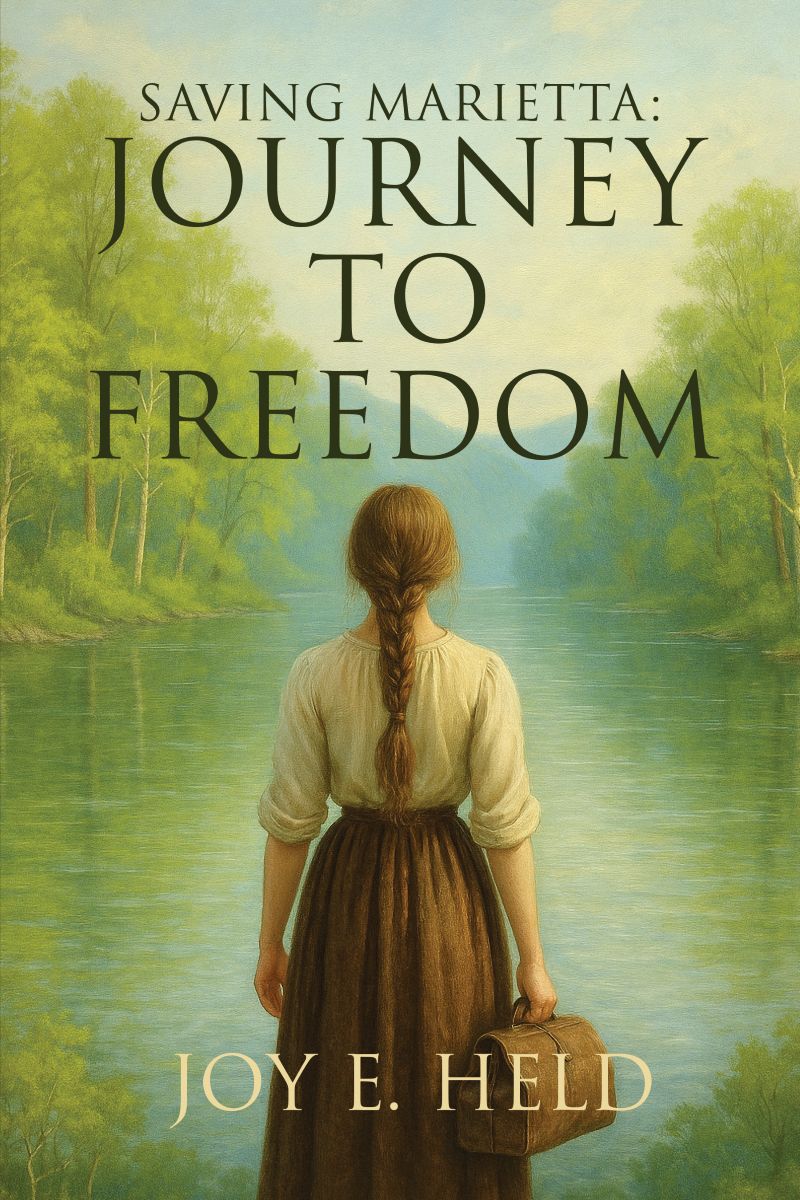
When Molly Hilliard is kicked out of physician training in Baltimore in 1796, she travels to join her family in The Northwest Territory in search of the freedom to become more than an herbal healer and dreams of saving pioneers from illness and disease until she literally loses everything in the icy waters of the Ohio River when her canoe overturns. Molly discovers that her medical school sponsor, Dr. Andrew West, has followed and caught up with her in Pittsburgh, and she must trust strangers to help her evade the meddling man who is hell-bent on marrying her.
Romney Applewood survived ten years as a captive among the Delaware natives when The Greeneville Treaty between the U. S. and the Indian Nations frees all white captives, and he is finally able to search for his younger sister who has been living with another tribe. Just as he is about to take her to a doctor in Boston to help Sarah Jane talk again, she is kidnapped. Suddenly he is back on the frontier searching for his sister despite there being a bounty on his head for “aiding and abetting the enemy”.
Molly and Romney’s destiny is sealed when they bond over saving others from drowning, bullet wounds, and smallpox, but he doesn’t want Molly’s dreams to be shattered by his past and thinks the best thing is to leave her in Marietta to forge a future as a doctor. His brain says go, but his heart shouts never let her go!
Saving Marietta: Journey to Freedom, Book 1
Joy E. Held
$19.99
ISBN 9781958914922
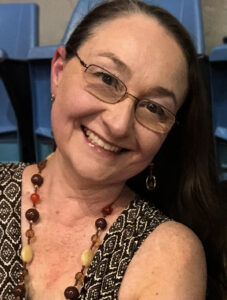
Joy E. Held is an author, educator, book coach, and yoga teacher living in West Virginia with her family. She enjoys herb gardening, junk journaling, and walking. She is a member of The Authors Guild and The Society of Children’s Book Writers & Illustrators. Joyeheld.com
Disclaimer: This article may contain affiliate links although I have never made a single dime from one, I’m required by law to provide a disclaimer.
If I am a workaholic, I don’t care.
Honestly, I’m pretty sure I am a workaholic, but I’m not going to blame anyone else. Growing up, I had intense role models. My parents and extended family members were all middle class and had to work incredibly hard to make ends meet, food appear on the table, and apparel that met the fashion expectations of the day available to everyone. If we were poor, I didn’t get the memo, but I also don’t remember wanting too much besides a book to read, the time and freedom to read it, and paper and pencil with which to write my own poems and stories.
When I was twelve years old, my parents, who were self-employed (my Dad actually worked two jobs year-round; one full-time and one part-time, both as a contractor,) decided I should be more conscious of the money necessary to run a business and a household. I was happy to learn and by the age of fourteen I was keeping the financial books for both of them. As the family bookkeeper for two entrepreneurs, did I maybe see too much work going on? Did I assume everybody worked all the time? I don’t remember thinking that, but perhaps it influenced me more than I knew, because flash forward I will work, work, work until something is done or I run myself into the ground and get sick.
Something called the Bergen Work Addiction Scale entered the world around 2012. It was compiled by researchers in Norway and the United Kingdom and administered to over 12,000 working Norwegians. It’s based on the traditional psychological conditions indicating addiction to anything and is developed in specific accordance with the principles of work. Here are the seven basic criteria of the Bergen scale:
You think of how you can free up more time to work.
You spend much more time working than initially intended.
You work in order to reduce feelings of guilt, anxiety, helplessness and depression.
You have been told by others to cut down on work without listening to them.
You become stressed if you are prohibited from working.
You deprioritise hobbies, leisure activities, and exercise because of your work.
You work so much that it has negatively influenced your health.
How many do you recognize in yourself? I meet six of the seven. Whatever.
To save me from myself, my Mom introduced me to yoga when I was eighteen. She probably recognized the type A (for Always busy) oldest child syndrome leaking out. Because I was a competitive gymnast, hatha yoga suited my twisty-twirly, boneless body just fine. Consequently, I have practiced yoga and meditate to counterbalance my worker bee personality ever since.
And although not much is said about it, the dirty little secret of gymnastics AND ballet is that you can’t do that stuff forever. THAT has haunted me forever. The last day of ballet, the last day of back handsprings, and the last night of reading till dawn were difficult for me.
The last day of storytelling will inevitably make its appearance. That will be a really tough one. Eyes, hands, shoulders, spine, and hips will eventually stop cooperating. My pragmatic side gets this. My creative side says, “Get this shit done before you can’t!” So, I read books, write books, sell books, and help others with their book needs while I can and until I can’t.
That’s why I am a workaholic. One day the work won’t work.
Are you a workaholic? I took this test on the Psychology Today website and scored a B-. Well, damn. I would love to know what you score. Remember to take such things with a healthy, side-eye of skepticism.
One of my many projects is My WriteDay bi-monthly subscription box for writers, and it opens to new subscribers Monday, March 2 at noon eastern. Each box is packed with a new writing craft book, office essentials, healthy snacks, and items to support a writer’s creativity and health. The March-April 2026 box is “Picture Book Perfection.”
Advertisement
Would you like to see your book advertised here? Just $20. Contact me at writerwellness@gmail.com
JOY E. HELD is a busy author, educator, editor, book coach, entrepreneur, and literary citizen responsible for this site and its contents. She is the author of
Writer Wellness: A Writer’s Path to Health and Creativity (Headline Books, Inc., 2020)
Writer Wellness Workbook: A Guided Workbook and Journal to Accompany Writer Wellness: A Writer’s Path to Health and Creativity (Headline Books, Inc., 2023)
The Mermaid Riot (Fire and Ice YA, 2024) Young Adult Historical Fantasy
Saving Marietta: Journey to Freedom, Book 1 (Headline Books, Inc., 2026) Adult Historical Romance
She is the winner of multiple writing and book awards:
West Virginia Writers, Inc. Annual Writing Contest, Honorable Mention, Novel, 1998.
New York Book Festival, Honorable Mention, Writer Wellness, 2020.
Next Generation Indie Book Awards, Finalist, Writer Wellness, 2021.
Northeast Ohio Romance Writers of America, Member of the Year, 2020.
Northeast Ohio Romance Writers of America, First Book Award, 2020.
She is an adjunct faculty member in the Southern New Hampshire University Online MFA Creative Writing.
She is a proud graduate of Seton Hill University in Greensburg, PA with an MFA in Writing Popular Fiction.
She is a member of The Authors Guild and the Society of Children’s Book Writers and Illustrators.
Joy is the founder and CEO of My WRITEDAY Subscription Box for writers and readers.
I write rough drafts in a hurry. For many years I followed the original rules of National Novel
Writing Month, even after those rules loosened up: write at least 50,000 words of a new novel
entirely within the month of November. I would make notes on a few characters and some
possible scenes during October, and sometimes do a little research, but I saved starting the actual
text for November 1 st . That meant averaging 1,667 words a day, a pace which kept me from
spending hours editing and fretting over what I’d already written. In recent years I’ve allowed
myself to start in late October, but I still aim to reach (and usually pass) the 50,000 word mark by
the end of November. More often, November 30 th or the first few days of December find me with
a very rough draft about 55K-65K words long.
Very rough. Typical problems include inconsistent character descriptions, inconsistent plot
developments, unheralded changes in point of view or character descriptions, characters
introduced early on who vanish for the rest of the book, and characters with identical names. I’ve
even had characters come back from the dead, with no intention or fanfare. Promised or
foreshadowed plot events may never materialize. On a more technical level, there are often too
many filler words such as “very,” “quite,” “somewhat,” “almost,” “feel,” and (in some uses)
“that.” These words create unnecessary distance between the reader and the point of view
character, or dilute the impact of what’s happening. Two or three or more characters may also
have identical speech habits and vocabularies, instead of their “voices” reflecting their
geographical origins, educational levels, and personalities.
So I jump right into fixing all these problems once the draft is finished – yes?
Well, no. I’ve found it’s better to wait a few weeks and approach the draft with fresh eyes. The
closer I can come to experiencing the draft as a reader instead of a writer, the better my chances
of seeing these problems. Then I can put my writer hat back on and start solving them. I can also
see where the story is too thin, where it needs a deeper dive into a character’s motivations or
trauma, where a subplot could add interest or an existing one is pointless or distracting. And I
can see whether the parts of the story that should move me as a reader actually do so.
It’s not always easy to step back after a month of working on the draft every day. There’s no
feeling quite like the creative impulse on simmer, the way my subconscious sneaks in and turns
the heat up so that it boils at 2 a.m. and compels me to scribble down a barely legible idea on my
bedside note pad. But I know, by now, that if I want the book to be good in the end, it needs this
fallow time.
KAREN E. WYLE
Karen A. Wyle is a retired appellate attorney and the author of multiple novels in a bewildering array of genres. She has been married more than thirty-six years and has two wildly creative adult offspring. She lives between two small dots on the map in south central Indiana, more or less in the woods. http://www.KarenAWyle.com
Disclaimer
This article may contain affiliate links which may result in the author receiving a commission when readers purchase items through the links.
You are receiving this message because you previously signed up for notifications or participated in a program/course with Joy. You may unsubscribe at any time.
Yep. You missed it. The November/December My WriteDay subscription box for writers “Another Perspective” has sold out. I understand. The chaos and money crunch of the holidays made it feel like time won the race again. Everyone on your list got something. That’s good. Now it’s time to do something for YOU!
For $59.00, My WRITEDAY is a bi-monthly subscription box containing curated products from authors, creators, and small businesses to writers and readers in the continental U.S. only. (Sorry no international shipping yet.) It’s unique in that many products are sourced from writers who are also crafters and artisans.
Each box delivers a writing craft book and 3-7 items associated with the key concepts (journaling, fitness, relaxation, nutrition, and creative play) of Writer Wellness, my flagship program and book (Headline Books, Inc. 2020.)
Inspired by literary themes, genres, and holidays, boxes include exclusive access to My WRITEDAY Digital Magazine filled with writing and publishing tips, writer wellness ideas, fiction excerpts, poetry, special offers, live virtual meetings, and more.
I have thoroughly enjoyed the My WriteDay subscription boxes. They are filled with useful items and resources for writers and all creatives at all levels. Joy is a talented curator, knowledgeable, supportive, and friendly. I recommend this box to anyone who is interested in writing and wants to boost their creative skills and lifestyle.
~Jessie M.
Click here to subscribe on MONDAY, JANUARY 5 AT NOON EASTERN STANDARD TIME!
“Your Writing As a Gift to Those You Love & Care About”
Monday 8 December 2025
Hey there, writer! This year give your writing as a gift to those you love. Lots of crafters give their creations as gifts. Writers can too. Here are some special projects you can quickly and charmingly turn into presents for the holidays.
WRITE A SHORT STORY WITH A RELATIVE OR SPECIAL PET AS THE STAR
Your wonderful talent with words easily translates into a short story or children’s book featuring a relative or special pet as the protagonist. It doesn’t have to be long or have a complicated plot arc, just a story about an adventure or a real-life event in the family history. You know the drill: start with a character with a problem to solve then say, “What if?” Illustrations in a digital book are easier than you think. Family photos from your phone will add personality and images from royalty-free sites such as The Graphics Fairy or iStock will more than supply you with ideas and appropriate art work to support the story.
CREATE A SERIAL STORY WITH A CHAPTER A MONTH
You only have to write one chapter to hook your reader for this gift of writing then write 11 more chapters that you send to the recipient once a month until next November when the romance is fulfilled, the mystery is solved, or the journey is complete.
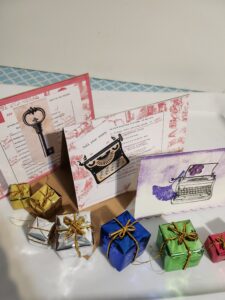
GREETING CARDS WITH WRITERLY QUOTES, IMAGES, AND MESSAGES
Or the cards can be blank inside. Blank, do-it-yourself greeting cards are available at most craft supply stores such as Michael’s.
OF COURSE, SIGNED COPIES OF YOUR PUBLISHED BOOK
Make this special by adding a letter to the recipient about how much you appreciate everything they do in support of your writing.
HOLIDAY CARDS & LETTERS FOR SERVICE MEMBERS
As the daughter and wife of members of various branches of the military, I think this gift of writing is one of the best you can offer. Thoughtful messages of support and appreciation are welcome. Places to submit include (check the deadlines at the websites):
This article may contain affiliate links which may result in the author receiving a commission when readers purchase items through the links.
You are receiving this message because you previously signed up for notifications or participated in a program/course with Joy. You may unsubscribe at any time.
My ideas are not ever meant as a substitute for consulting with a qualified health professional.
Advertisement
JOY E. HELD is an author, educator, editor, book coach, entrepreneur, and literary citizen responsible for this site and its contents.
Writers really aren’t that difficult to buy gifts for because much of the equipment and supplies they use runs out on a regular basis, but buying pens and copier paper for a writer is like buying a cookbook for a chef. Um. Here’s a list of goodies I know from experience the writer in your life will appreciate.
GIFT CARD FOR INTERNET OR MOBILE PHONE SERVICE
A writer MUST have internet access for research, marketing/promotions campaigns, EMAIL, social media, courses/webinars, professional memberships, and to stay up to date on current events associated with their work. It might surprise you to learn that almost all internet and phone providers offer gift cards, but you have to visit their websites for the best offers and service because cards are not always available on those mega-gift card racks in stores. T-Mobile and Verizon sell them online, AND they can be used to pay the gift card recipient’s monthly bill!
SMALL MASSAGE GUN (but not too heavy or small)
Of course, a gift certificate to a massage therapy clinic such as Massage Envy or a local spa will bring a smile to your writer’s face because sore hands, arms, shoulders, and backs come with the job. That said, a small hand-held massage gun is a wonderful thing to have near the desk and after a day of writing. Don’t go too small or too cheap because power is the name of the success game when it comes to reliability and usefulness. Something important to consider is the weight of the massage gun. A heavy one is difficult to hold with a tired hand. Check product specifications for weight before purchasing a heavy massage gun that defeats the purpose. Theragun Relief ™ is a good option.
MY WRITEDAY BI-MONTHLY SUBSCRIPTION BOX
My WriteDay subscription box for writers is created to do exactly what this post recommends: support your writer with education and gifts delivered every other month to their door. Each lovingly curated box contains a writing how-to craft book and a subscriber only digital magazine with articles and market news. A yearly subscription is $264.00 for six boxes and includes free US shipping. I have gift certificates ready to send as a way to let your writer know how much you believe in them and what they do. Purchase by Dec. 31 and their first box will ship in January 2026.
This article may contain affiliate links which may result in the author receiving a commission when readers purchase items through the links.
You are receiving this message because you previously signed up for notifications or participated in a program/course with Joy. You may unsubscribe at any time.
My ideas are not ever meant as a substitute for consulting with a qualified health professional.
Advertisement
JOY E. HELD is an author, educator, editor, book coach, entrepreneur, and literary citizen responsible for this site and its contents.
This article may contain affiliate links which may result in the author receiving a commission when readers purchase items through the links.
You are receiving this message because you previously signed up for notifications or participated in a program/course with Joy. You may unsubscribe at any time.
BLURB: Destinee was four years old when her mom tried to make her kill herself. The trajectory of her life was forever altered as the emotions associated with that night later became the foundation on which she would build her identity. After living with different families throughout the years, and conforming to fit in, she became desperate to find somewhere to belong and be loved for who she was – baggage and all. She struggled to find reasons to stay alive as the demons of her own past, and the demons which plagued her family for generations, threatened to crush her spirit. This is a story of one girl’s journey to overcome loss, search for love, and find redemption.
ABOUT THE AUTHOR: Destinee Brooke has always used writing as a therapeutic outlet, starting at a young age. She started writing The Girl Who Lived: The Story of a Resilient Heart during a creative writing class her senior year of college after realizing the healing power of writing about her trauma. Since then, she’s graduated with degrees in both English Education and Creative Writing. She’s made it her mission to help others, her students included, work through their trauma and bring awareness of how to overcome generational pain. She lives in West Virginia with her son.
JANE CARY, KAAREN CARY FORD, Editor
BOOK:Tuscawilla: Stories of a Farm
AUTHOR: F. Jane Cary, Kaaren Cary Ford, Editor
GENRE: Memoir; History
BLURB:Tuscawilla: Stories of a Farm is a collection of stories by the late F. Jane Cary about farm life in Greenbrier County, West Virginia, in the middle of the twentieth century. Cary lived her entire life on Tuscawilla Farm, eventually managing it after the deaths of her brothers. This fascinating account of the realities of post-war farm life features P.O.W.s, the ins and outs of hog butchering, how to make the perfect apple butter and much more. Cary’s unique personality and love of the world around her shines through, and takes the reader back to an America that can be hard to recognize.
ABOUT THE AUTHOR: F. Jane Cary (1923-1995) lived her entire life on Tuscawilla Farm, just outside of Lewisburg, West Virginia. She was the second daughter of the farm manager, and after the deaths of her father and two brothers, took on the position herself, managing all aspects of the farm from animal husbandry to gardening to cooking large meals for friends and family. In her youth, Cary had wanted to become a teacher, but ill health prevented her from finishing high school, and instead she instilled her love of West Virginia history and farming by instructing the many young people who worked for her. Well-known and well-liked, she rarely left home, and documented her experiences of the farm on many legal tablets, transcribed and edited by her niece, Kaaren Cary Ford, after her death.
BLURB: Ariel Matthew enjoys escaping into the worlds and adventures of her favorite books, but she can’t escape her past, no matter how hard she tried to push it from her mind. Haunted by a traumatic event, Ariel struggles to find peace from her memories of what happened. When Axel Stone walks into the small coffee shop where she works, her world is changed forever, and she begins to believe that happiness might be possible. But neither one of them is ready for the devastation that ensues when both of their pasts come back with a vengeance.
ABOUT THE AUTHOR: Molly Kendall is quick-witted and quiet, and appreciates a dramatic story when she reads one, as well as crafting such tales of her own. She aims to inspire hope within her readers hearts as she shines light onto darker topics. When she doesn’t have her nose stuck in a book, you can find her at home with her husband, cats and bunnies.
BLURB: When a greedy, scheming relative drives Ellie Waltham and her mother from their home, her brother-in-law Gareth Delaney steps in, but safety is short-lived when Ellie is abducted in an attempt to force her to marry someone she knows intends to kill her so he can claim her inheritance. Only a last-ditch effort by Ellie will save her from certain death.
ABOUT THE AUTHOR: Barbara Jean Miller is an author, educator, and nature observer.
BOOK:Mission to Madagascar: The Sergeant, the Jing and the Slave Trade
AUTHOR: David H. Mould
GENRE: Historical Biography
BLURB: In 1817, James Hastie, a 30-year-old East India Company sergeant, travelled to the court of Radama, ruler of the most powerful kingdom in Madagascar, to convince him to stop the export of slaves. Radama manipulated the envoy to assert power over the nobility who profited from the trade. Hastie became the British agent, and a trusted advisor to the king. Mission to Madagascar is based on his unpublished journals, one recently discovered. This is the first biography of a man, whom Sir Mervyn Brown, a former UK ambassador and historian of Madagascar, described as “one of the most important figures in the history of Anglo-Malagasy relations.”
ABOUT THE AUTHOR: David Mould, Ph.D., Professor Emeritus of Media Arts and Studies at Ohio University, has published books and articles on a range of historical topics, including news and documentary film in World War One, canals and railroads in the 19th century in the US Midwest, television coverage of the first Gulf War, post-Soviet media in Central Asia, and oral history. Born in the UK, he worked as a newspaper and TV journalist before moving to the US. His essays and articles have been published in Newsweek, Christian Science Monitor, Times Higher Education, History Ireland, History News Network and other print and online outlets. He has published three books on travel, history and culture. He is a frequent presenter at libraries and for adult learning classes.
JOY E. HELD is an author, educator, editor, book coach, entrepreneur, and literary citizen responsible for this site and its contents. She is the author of
Writer Wellness: A Writer’s Path to Health and Creativity (Headline Books, Inc., 2020)
Writer Wellness Workbook: A Guided Workbook and Journal to Accompany Writer Wellness: A Writer’s Path to Health and Creativity (Headline Books, Inc., 2023)
The Mermaid Riot (Fire and Ice YA, 2024) Young Adult Historical Fantasy
She writes spicy historical fiction under a pen name.
She is the winner of multiple writing and book awards:
West Virginia Writers, Inc. Annual Writing Contest, Honorable Mention, Novel, 1998.
New York Book Festival, Honorable Mention, Writer Wellness, 2020.
Next Generation Indie Book Awards, Finalist, Writer Wellness, 2021.
Northeast Ohio Romance Writers of America, Member of the Year, 2020.
Northeast Ohio Romance Writers of America, First Book Award, 2020.
She is an adjunct faculty member in the Southern New Hampshire University Online MFA Creative Writing.
She is a proud graduate of Seton Hill University in Greensburg, PA with an MFA in Writing Popular Fiction.
She is a member of The Authors Guild and the Society of Children’s Book Writers and Illustrators.
Joy is the founder and CEO of My WRITEDAY Subscription Box for writers and readers.
May 2-Rainy as usual, but maybe that will clean the drive path in front of the castle before Mr. Harker arrives tomorrow. I wish he hadn’t left London so late. Something about trial notes to finish. It is a long journey to Transylvania. With only one stagecoach every day it will be the middle of the damn night when I get him back here. Must remember to put brandy and an extra blanket in the carriage. I hope that ridiculous woman at the Golden Krone remembers to give Harker my letter.
May 4-Snow. A little early for this kind of chill, which keeps the peasants out of the forest. Makes things more challenging, but I’ll manage. Englishmen require too much luggage! How long does H think he’s staying here? H is paler than I expected. But I like the look. And afraid of my dogs. I thought he’d never stop quivering on the ride up the mountain.
May 5-H liked the baked chicken and drank an entire bottle of wine for supper.
May 8-H cut himself shaving. I nearly lost it. He didn’t need to shave for me, but it caught me off guard. Suddenly, I couldn’t control myself. Why in the hell is the Englishman wearing a crucifix of all things and where did he get it? The zap also caught me off guard. I regret throwing H’s shaving mirror out of the window. I just couldn’t stop myself.
May 16-Certain H saw me leaving the other night. I told him not to wander around the castle. I told him to stay in his room and not to fall asleep in any other room. It’s his own fault. If I hadn’t smelled his fear, I might not have made it to his rescue. Those girls will be the death of me. This man does not follow instructions well. I hope he hasn’t made careless errors on my London property purchase. Ah, what’s done is done. This man is mine, ladies.
June 1-Had to hide all the paper. Judging from H’s journals, he is pretty shook up about having to stay here another month. I could let him write that letter for help he craves and tell him I mailed it for him. Not. Decided to get his traveling clothes cleaned for him. I think I forgot to tell him this.
June 30-Damn! He found me in the shipping crate. Meddlesome fool. Do all English lawyers behave so badly? Have to go to London without him for now. Why does everything have to be such a bother?
I love epistolary fiction. Reading the letters, journals, diaries, and newspaper clippings allow me a deeper connection to the writer. I learned the habit from doing research for my historical fiction novels. I also really love special collection departments and their librarians. Special collections librarians are amazing sources of information and always ready to help a writer or student with research. Another topic for another day.
Consequently, I am drawn to collecting and reading the diaries and letters of published authors. I enjoy reading about what was going on in their lives and the world when they worked on a particular book. I’m currently rereading A Writer’s Diary written by Virginia Woolf and published/edited by her husband after she died. I love Journal of a Novel: The East of Eden Letters by John Steinbeck and have just started reading Letters of Edna St. Vincent Millay. I haunt used book sales for the older versions of these kinds of books because there is less editorial commentary than there is in contemporary reprints of such works. I like to come to my own conclusions.
This passion partially explains why I annually reread Dracula by Bram Stoker. I’m not so enamored of vampire literature. It’s the journals, letters, and newspaper clippings that Stoker uses as a narrative technique that draw me to the book. I’m more interested in the style and conventions he chose to tell the story with over the romanticism of vampiric folklore. While the diaries and journals of published authors are written in their own hand, it’s a straightforward connection to a new perspective on their published works. In Stoker’s case with Dracula, he chose one of the most difficult literary conventions. The unreliable narrator.
The unreliable narrator in literature is exactly what it says: a character telling a story, but you shouldn’t trust everything that character says. And what better way to stay true to a character’s viewpoint (and their own opinions about themselves and the story’s actions) than explaining the plot through their fictitious accounts—their diaries?
Some people tell the truth in their personal writings. Others are prone to embellishments. Everyone expresses an opinion about what happened. That’s called reflective writing. It is cathartic and authentic, written from the heart and emotions but not always from the intellect or common sense. Personal writing is for the writer at the time, although they generally have a suspicion that someone will read their journals after the holder of the pen has died. I write notes in my journals all the time to my children and grandchild for them to read long after I’m on my way to whatever is next after this part of my karmic journey.
The other interesting problem Stoker chose is that because of the “personal” writings used to tell the story, the author himself is forbidden to provide narrative comments on what the characters are saying and doing. He can’t narrate or explain anything in his own book because he can’t interfere with what the characters are writing then doing. He must stand back, relay the writing and deeds, then leave it to the reader to conclude as they will. Until you realize Stoker IS offering narrative commentary because he is the one writing the journals of his characters.
Each character in Dracula is unreliable because they have personal agendas that Stoker wants the reader to recognize-social justice, high morality, sexual repression, and the greater good of society. They each wish for a position in life other than what they are shackled to. They don’t want to be who they are and feel compelled to lash out at something they consider evil to assuage their own unhappiness. Happens all the time. However, most unhappy people complain in their journals and letters then go out into the world and act as normal as possible even if they secretly want to drive a stake through the heart of the devil. That’s what fiction is for.
Have you ever been backstage at a theatre production? In the performer’s dressing room, and many times in the side wings where they wait to go on stage, are a lot of mirrors.
Dancers have a misguided reputation for being vain because they rely on mirrors as they train. Supposedly, a dancer can’t walk by a large window or even the tiniest mirror without a sideways glance at themselves. Some habits are harder to break than others.
The showstopping musical number from the Broadway musical A Chorus Line is sung by the lead character, Cassie, who is the aging chorus girl trying to make a comeback. “All I ever needed was the music and the mirror and the chance to dance for you.” Yep. That’s an amazingly accurate statement about what being a dancer means. The actress Donna McKechnie put this song and dance number on the eternal map of musical theatre’s most powerful performances because her passion for dancing, initially ballet, had nourished her soul from a very young age.
There’s no shortage of commentary and speculation about why or what Stoker intended by writing Count Dracula as invisible in mirrors. No soul. Not living. Ashamed of what he’d become. Violent at the thought of anyone looking at their reflection saying, “And this is the wretched thing that has done the mischief. It is a foul bauble of man’s vanity. Away with it!” He throws the shaving mirror out the window to shatter on the cobblestones below. As if shards of a mirror are acceptable while the whole is not?
The folklore surrounding mirrors could have influenced Stoker, but as I mentioned, writers gather and weave strands from everywhere for a long time before something appears in a story. Yes, the soul of a person is a major theme in Dracula but recall Stoker’s career as a theatre critic and business manager. Whether or not Stoker ever acted in a play isn’t documented, but once he got an all-access pass to the inner workings of what it means to be an actor, he had to have been awed by a performer’s reliance (and sometimes addiction) to their own reflection. Stoker was and never dropped his role as a critic. Someone who offers feedback to a performer…just like a mirror.
The phrase “smoke and mirrors” has been a theatrical technique since the late 18th century when magicians used it to project an image onto smoke to make the image look as if it were floating, shimmering, or hovering. If that image happened to be a person, they were called spirits and ghosts. Fast forward and the words suggest that what someone is seeing or being told should be investigated vigorously to be sure there is truth there. It’s been a go-to idiom in political commentary since the 20th century. Stoker had to have encountered the practice in 19th-century theatre because it was a very popular stage trick to make the audience believe in something that actually didn’t exist.
See where is leading?
Mirrors (not fun-house distortions) tell the truth. No matter how tiny the shard, the reflection is an exact image with an unbiased, untainted message (wicked Queen in Snow White exempted from this discussion.) This is precisely what you look like and the first impression others will have of you. That truth is the reason performers are trained to use mirrors as a means to improve and as a way to see what needs correcting. Look in the mirror. Pants unzipped. Zip. Go out on stage. The mirror also cuts down on what the critic has to complain about. All the world is a stage.
When Jonathan Harker looked into the mirror to shave then felt Count Dracula’s hand on his shoulder (a common place for the imaginary characters of angel and devil to sit) he cut himself with the razor because the “visitor” surprised him. Snuck up on him. Harker claims to have been able to see the whole room in the reflection, but he didn’t see the physical embodiment of the devil behind him. He only felt his presence in his own physical body.
First lesson in smoke and mirrors: be careful what you project for it has a truth all its own.