Female agency is old news if you know where to look (historical romance)

20191225_161605

I don’t remember when I read my first romance novel, but I do remember writing my first play in which a romance figured prominently. I wrote a western about a young woman whose father had been killed by bandits, and the local town banker offered to marry her to “save the ranch.” Keep in mind, I was ten-years-old. What my heroine didn’t know was that the banker had paid the bandits to kill her father so the bank could foreclose on the very prosperous ranch.

A young cowboy traveling through town happened to witness the murder and told the heroine, then helped her prove to the sheriff what the unscrupulous banker had done. The cowboy was also the son of a wealthy mine owner from another town and had the money to save the ranch and marry the girl. The hero saved the day then.

In my current work-in-progress, things have changed. My heroine makes her own path, her own choices, and meets her own destiny with a handsome, strong, yet flawed hero at her side who meets and conquers his own demons along the way. They simultaneously prove to each other that they are worthy of the other’s respect and love by owning up to their mistakes, their past, and making conscious decisions to be different in the future in exchange for the love of the other. I don’t feel like this is a radical departure from the halls of historical romance.

Kaye Mitchell writing in The Cambridge Companion to Popular Fiction pokes me in tender places with her statement, “If mass-market romance fiction of the Mills and Boon/Harlequin variety has, in the last couple of decades, become more forward-looking and complex in its depiction of educated and ambitious heroines and its inclusion of more explicit sexual material, it has perhaps had to evolve in order to compete with its more ‘respectable’ offshoot, chick lit” (134). I don’t understand where the ‘respectable’ notion comes into play for chick-lit implying that educated, ambitious, and sexy heroines of past romance fiction aren’t respectable. There are hundreds of ‘educated and ambitious heroines’ in novels published well before Bridget or Samantha ever dreamed of meeting/marrying Mr. Right.

As a historical romance, my novel falls in between the rancher’s daughter and Bridget Jones because it has a female protagonist with a goal and a plan, but unlike the rancher’s daughter and Bridget, my heroine takes all the responsibility upon herself to make her dreams a reality. My wip recalls the early heroines of romance authors Connie Mason and Barbara Cartland while proposing that women have had dreams and goals since the beginning of time.

My heroine doesn’t believe (or comprehend) that she is dependent on men to realize her desires. What interferes is the environment. She is thrust into a harsh situation where it becomes obvious that she must become part of a team to survive the elements. This is where she evolves as a human being when she comes face to face with people and lifestyles different from what she is accustomed to. She adapts and finds a new inner strength that she didn’t know she had.

Mitchell disappoints me when the only time she mentions female empowerment is with, “In addition, although affirmative readings of these memoirs tend to highlight the emphasis on female pleasure and (sexual) agency, that is an emphasis that is often undermined by the content of the texts themselves” (136). Mitchell does a disservice to female agency through the ages by leaving out the fact that there is more to being a woman today and throughout history than place tab ‘A’ into slot ‘B’.

In my story, the heroine knows pleasure, intimacy, and personal satisfaction by applying what she has learned in her education and knows in her heart to help others prosper and live up to their potential thereby bolstering her own worth as an individual. Proving that it is not a flaw to be, in Mitchell’s terms, “gendered, desiring individuals in the world.” That definition is exactly how and why we complement each other.

All good things,

j
JoyHeldHeadshot3


Mitchell, Kaye. “Gender and Sexuality in Popular Fiction.” Glover, David and Scott McCracken, eds. The Cambridge Companion to Popular Fiction. Cambridge: Cambridge University Press, 2012. 122-140.


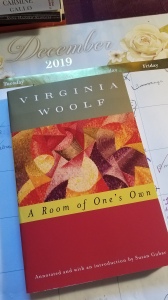
Woolf, Virginia. A Room of One’s Own. Orchard Park, NY: Broadview Press Ltd., 2001.

Fear takes longer to experience in the human brain

20191225_161432

I’ve been rereading The Cambridge Companion to Popular Fiction, edited by David Glover and Scott McCracken. I can’t explain why except that the current upheaval in publishing is making me ask questions about the history of the business. In Chapter Six “”Reading time: popular fiction and the everyday,” editor McCracken makes some important points about what happens to readers when they read. Knowing more about reading and how a reader’s experience might affect my writing is definitely a question worth asking. McCracken provided me with a variety of diving boards from which to jump into my own head or other texts. I am drawn to this sentiment from Chapter Six:

The thriller thus allows for different forms of attention, which rely on a comprehensive knowledge of what to expect from the genre, a knowledge culled not just from written fiction, but also from film and television. Yet despite the familiarity of the structure, like the popular song, the successful thriller has to have a ‘hook’, an intriguing element of originality, which draws the reader in (Cambridge 112).

McCracken’s “forms of attention” triggered my curiosity about how I could understand his meaning and apply it to writing romance. While McCracken focuses on thriller novels for this thought, he is really talking about the tension and pacing of a novel. Romance has a sub-genre of romantic suspense, but all romance fiction has some degree of tension derived from the question “will they or won’t they?” The suspense of not knowing the answer and vicariously living the struggles the heroine and hero endure on the way to resolving the question is the same as “will the detective figure this out?”

McCracken emphasizes his premise with three primary examples that thriller novels can/do focus on different forms of attention, and I wondered what that meant in terms of how the brain deals with time (which underlies McCracken’s chapter) during different kinds of stress/excitement/worry/etc. Why does one form of attention in a thriller appeal to readers more than others?

I found a kernel of an answer in  The Secret Pulse of Time: Making Sense of Life’s Scarcest Commodity written by Stefan Klein who says:

The way we judge the length of an interval of time depends not only on the gauge the brain uses to estimate the elapsed time but also on the degree of our focus. If consciousness is occupied with other matters at the same time, we underestimate the time that has passed; if we are hyperalert—for example while watching an act of violence in a film—the seconds expand (62-63).

My interpretation of this is if a reader (or viewer) is thoroughly absorbed by a scene, paying more focused attention, the time will feel longer to them. The less engaging the writing or the acting, time will seem to pass more quickly for the reader/viewer because the brain is susceptible to distraction. It’s the difference between quickly scanning the pages of a magazine (distracted focus) and examining every detail of one particular page for several minutes (deep attention.)

Klein claims that during intense action it is the “sense of dread that makes the scene seem agonizingly long—like waiting in the dentist’s chair in view of the drill” (63) that captures the reader’s brain and holds them spellbound.

Therefore, my writing needs to include more showing and less telling to increase the reader’s vicarious experience with the action, and this will have positive effects on the degree of tension and pacing in my story.

All good things,

j

JoyHeldHeadshot3

Klein, Stefan. The Secret Pulse of Time: Making Sense of Life’s Scarcest Commodity. Cambridge, MA: Da Capo Press, 2007.

McCracken, Scott. “Reading Time: Popular Fiction and the Everyday.” The Cambridge Companion to Popular Fiction. Ed. David Glover and Scott McCracken. New York: Cambridge University Press, 2012. 86-102. Print.

“What is middlebrow?”

On the airplane coming home from a humanities conference recently, the woman sitting next to me was reading Written in My Own Heart’s Blood (2016) by Diana Gabaldon. Intermittently, she put down the novel and picked up the knitting in her lap. Her progress told me that she was making a baby sweater.

Gray hair, traveling alone, reading an 1152-page historical novel, and knitting represents one end of the spectrum of readers who enjoy historical romance. The other end of the spectrum stated in a 2013 SquareSpace study of romance fiction statistics maintains: minimum age 30, college-educated, minimum income $55,000/year (Static).

I asked my seatmate if she’d read Gabaldon’s other books in the series.

“Every one of them,” she replied emphatically.

I remarked on the average page count of a Gabaldon work to which she answered, “I’ve read a couple of them twice.”

Before deplaning, I wanted to know why.

“Jamie.”

Not the historical accuracy, not the cable television series, and not being part of a community, but the draw of the character. Just when I thought surveys and social media were gospel when it comes to understanding readership, I bump into Nana.

I stopped to think, not only about my potential readership but the impression of my beta hero, whose quiet nature may make him appear too passive to survive frontier life, let alone the prejudice and ostracism guaranteed for him following ten years as a captive of the Delaware Indian tribe during the American Revolution.

Would this woman on the plane, obviously intellectually, physically, emotionally, and financially capable of appreciating historical romance fiction, be attracted to my hero?

More important (well, maybe) to this conversation is how high or not is her brow?

The literary term ‘middlebrow’ rubs me the wrong way. Reminds me of a relative’s unibrow curse. I’m familiar with the condescending attitude the terminology implies as also noted by author Nicola Humble in “The reader of popular fiction”:

“The concept of the middlebrow is a notoriously vexed one. ‘Middlebrow’ has always been a dirty word. Since it’s coinage in the late 1920s [there’s some discrepancy about this date] it has been applied, almost always disparagingly, to the sort of cultural products thought to be too easy, insular and smug” (Cambridge 92).

Briefly, ‘highbrow’ and ‘lowbrow’ are outgrowths of the questionable science phrenology presented in 1796 by German physician Franz Joseph Gall. He claimed that bumps on the head were directly related to “organs” in the brain that he associated with a range of functions such as someone’s propensity to love or tell secrets.

This pseudoscience was short-lived by the 1840’s across Europe and America. Those that will bastardize picked up on phrenology and claimed that having a high forehead indicated intelligence and a short forehead pointed to less mental capacities. I was unable to find anything pointing directly to Gall proposing these stereotypes. I’m not defending the concept, but the father of phrenology didn’t intentionally mean for it to be used as a class, racial, or intellectual divisor (Manual of Phrenology 83). But it has been and obviously continues.

Do I think the baby boomer grandmother would appreciate my historical romance? I do. There is a 2013 survey by author M.K. Tod that supports this here. P.S. Note in the report where baby boomers say they primarily learn about new books.

All good things,

j

JoyHeldHeadshot3

Humble, Nicola. “The Reader of Popular Fiction.” The Cambridge Companion to Popular Fiction. Ed. David Glover and Scott McCracken. New York: Cambridge University Press, 2012. 86-102.

Manual of phrenology : being an analytical summary of the system of Doctor Gall, on the faculties of man and the functions of the brain : translated from the 4th French ed. Philadelphia : Carey, Lea & Blanchard, 1835.

“Romance Fiction Statistics.” Static1, SquareSpace, 24 Jan. 2019, http://writerwellness.files.wordpress.com/2020/03/4059e-romancestats.pdf

“10 Facts on Boomer Readers.” Inside Historical Fiction, 24 Jan. 2019, https://awriterofhistory.com/2015/11/09/10-facts-on-boomer-readers/


“Write what you know”

CURSIVE INK kelly-sikkema-399338

I read, write, and study historical romance. My most recent completed manuscript is 470 pages long and currently designated as “historical fiction with romantic elements.” The distinction is because the couple in the story doesn’t meet (meet-cute) by page five of the novel. This is kind of a burr under the saddle for me because I believe that historical romance readers, no matter how experienced, want and appreciate the world-building and character motivations at the start of a book regardless of how long it takes for the two main characters to eventually collide.

However, the contemporary industry standard of the heroine and hero appearing within the first five pages is applied across the sub-genre board. So, I’m presently stuck with the label of “historical fiction with romantic elements” because a lot has to happen to Molly, Romney, and America before they find each other and start their journey together. I hope that makes sense. At first, I was dismayed by the nomenclature, but I’ve embraced it now because it’s not that big of a deal…until I go agent and publisher shopping. Since I don’t have time to pursue that part of the process yet, I’ve decided not to angst over it. Spoiler alert: Molly and Romney end up together.

Typewriter045

The book is my response to “write what you know” and to fill a void in historical romance offerings. Frontier America, specifically the Northwest Territory, was a rough era and not viewed by some publishers and readers as romantic enough to be a popular setting or time period. I live and work in the belly of this particular beast, aka The Mid-Ohio Valley, and the research is literally at my fingertips. My house is near the Ohio River where my characters almost drown. I work on the campus of a local college whose library has one of the most extensive Special Collections of pioneer history in the country. There are actual pioneer cabins preserved and on display in a local museum that I drive by every day on the way to work.

However convenient, it hasn’t been easy, but I don’t read, write, and study historical romance because it’s easy. I do it because I’m fascinated with the human project. I’m in total awe of women who cooked without an electric stove or wiped up spills without paper towels or any number of other modern civilities we live by today that were non-existent in early America.

They must have been really strong-willed people driven by something that helped them survive seriously difficult situations so that you and I can be doing this amazing thing (having a meeting of the minds via technology) right now. I think the “something” that propelled and motivated them was love, and I respect the hell out of the men and women who paved the way for me in spite of the mistakes they made. I read, write, and study historical romance out of respect for the past, curiosity about humanity, and the love of words. Most of all, I want to believe that love conquers all. So, don’t burst my bubble, okay?

I’ve gone overboard with telling you a “little” about my project. Now, you understand why my manuscript is so long.

I’m more concerned about the condition of the publishing industry lately than the length of my manuscript. We live in the “United States of Amazon,” and it’s their prowess and whims that have me wondering constantly how to really connect with readers. Publishing is the EASY part thanks to Amazon (and others) literally giving birth and providing respectability to the self-publishing concept, but I worry about getting the message out to pull readers into my books. More on this later.

All good things,

j

JoyHeldHeadshot3