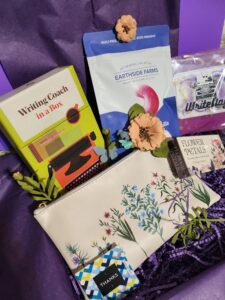
It’s time to unwrap and take a look at the “My Writing Coach” box for May/June My WriteDay subscribers!
What writer hasn’t dreamed of having a solid writing coach at arm’s length with a good pair of editing eyes and a cache of great ideas to help create and polish a piece of writing? Yes, we writers must work in solitude for the sake of focus and authenticity, but all of our writing eventually needs another perspective to offer constructive suggestions to improve the final product. I hope “My Writing Coach” offers this to you.
Let’s look at it all.
1. Writing Coach in a Box caught my eye during an inventory shopping session and made me chuckle at first because, like I noted, I would love to have a decent writing instructor and proofreader handy all of the time. I just never thought of keeping them tucked away in a box until I need them. Well, the writing craft “book” is this set of inspiring and practical writing tips from “author, publisher, and writing guru” Alan Anderson. The cards are worthy of spending random time to read through, pick one for a journaling session, sharing at writer’s critique sessions, and providing sound reminders of what it takes to write anything!
2. Flower Petals, Blossoming Guidance from the Garden is part of the flower theme for this box. Each card is beautifully illustrated and includes ideas for journaling prompts. The language of flowers is a real concept developed during the Victorian era as the study of botany flourished. From everyday household suggestions to hidden meanings of different blooms, these cards are a contemporary take on this idea. Use them to inspire journal entries, blog posts, or tuck them into the celebration cards you mail to friends and loved ones.
3. Blueberry Vanilla Cashews from Earthside Farms in New York will win over anyone who already loves to snack on nuts and those who have previously turned up their noses at this healthy treat. Earthside calls their line of products “snacking reimagined” which grabbed my attention because all writers are regularly in need of ideas and healthful snacks. I keep a bag on my desk for those moments when I need a munchie but don’t want to walk away from the work-in-progress. I would love to know what you think of these delightful treats.
4. Flowered Pencil Pouch (or make-up, markers, etc.) holder. Keeping with the theme of flowers, I’ve packed this pretty pencil pouch with bookmarks and office supplies.
5. There are reading andwriting stickers, a Thoughtfull pop-out journal prompt, and promotional bookmarks from some my author friends.
Also, I am experimenting with wrapping the boxes for a couple of reasons.
1)boxes were getting beat up during shipping
2)wrapping reduces the amount of tape and stickers on the boxes themselves
3)subscribers have told me that they keep and repurpose MWD purple boxes and would like for them to be in better shape after shipping
If you’re a current subscriber, what did you think of the wrapping paper? Better, worse, no opinion? I’d love to know.
Want to be a My WriteDay subscriber? Easy. Click here
My WriteDay Subscription Box
Next, I would love for you to follow My WriteDay on social media if you’re interested.
Why Writers Should Explore Other Creative Practices
It isn’t easy to create day after day despite what famous authors say about their work and schedules. Yes, you can develop a creativity habit as well a creativity mindset with a plan and practice. Sticking to the plan and practice is exactly how to set your creativity on “cruise control” but be aware that once this habit is learned, your brain will forever be an idea machine. With a plan and practice, everything you think, see, hear, and experience becomes fodder for your creativity. So, if you’re not interested in looking at a random playing card of the Queen of Hearts laying in the street while taking your morning stroll, don’t put this strategy into place. Once learned, it’s difficult to turn off, but then again, what’s an artist without ideas?
I actually came across that playing card while on a walk, and it was face-up in the street in front of a local saloon with a colorful history. At first, I went by until my brain quickly made the connection between the card, the bar, and the fact that I’m a romance author. I back tracked, picked up the card, and contrived a story in my head the rest of the way home. That’s what creative people do, but because I’ve always been this way, I didn’t think about how to coach others to be idea machines until I started homeschooling my daughters many years ago. Let me insert some context.
Creative inclinations are natural and instinctive to the human species or we wouldn’t be where we are today—for better or for worse. The development of survival and technological skills stems from 1) the need to survive and 2) the impulse to be more. My daughters are the blessings of two people trained from early ages in music, theatre, and dance. Both of my parents were artistically inclined as my father was a musician and my mother was a ballet teacher, each who had “day jobs” to support their artistic endeavors. Being from a small town, a small state, and choosing not to move away meant that it was challenging for my dad to make a living as a piano player. So he worked as a contractor. I made the same choice and my children inherited the “creative gene” so when it came time for formal education, I chose creative, engaging ways to teach language arts, math, social studies, and science. For example, I called chemistry “Potions Class” and framed the activities around the “science” lessons of Harry Potter. Because of this “creative heritage,” it was easy and fun for me and the girls.
I believe creativity is a natural instinct, but it also must be encouraged and practiced in order for it to stick. While there is a certain degree of natural creativity, it can definitely be a learned skill. At just about any age. As I noted, once creativity is practiced regularly, it becomes part of your everyday life. However, as I also mentioned, it’s strenuous to create day in and day out in the same field as writing or any artistic mode. Burnout, writer’s block, and imposter syndrome are the direct result of not exploring other creative outlets in my opinion. Playing around in other disciplines helps writers avoid these troubles.
Writers should dabble in other forms of artistic expression for four reasons:
Training the creative mind (creativity on “cruise control”)
Relaxation (creating in another art form can be relaxing)
Recognizing that the “creative process” is universal (all art follows certain procedural steps)
Appreciating other artists (discovering a commonality with other artists/art forms)
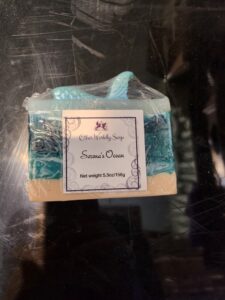
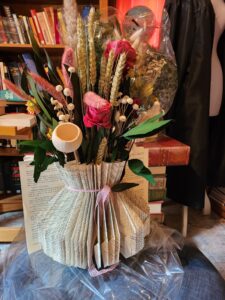
I do this myself by dabbling in junk journaling and book folding art. I support other writers who do this by purchasing their products like soap and candles for My WriteDay subscription box. With a plan and practice, you can set your creativity on cruise control or autopilot* and go along for the ride. This article “Creativity on Autopilot” explains the principles of planning and practice.
Regardless of your primary art discipline, do you dabble in other art forms? How does it support you? If you came across the Queen of Hearts laying in the street outside a bar, what would your creative brain think?
You are receiving this message because you previously signed up for notifications or participated in a program/course with Joy. You may unsubscribe at any time.
This article may contain affiliate links which may result in the author receiving a commission when readers purchase items through the links.
My ideas are not ever meant as a substitute for consulting with a qualified health professional.
Advertisement
Perfect Strangers by Barbara Jean MillerBuy me a coffee
*Fun Fact* Autopilot was patented by American inventor George De Beeson in the 1930s. During World War II, the slang for using it was, “George is flying the plane now” which is rumored to be a reference to King George VI who technically owned the plane or it might be a nod to the inventor. https://en.wikipedia.org/wiki/Autopilot
No, we are not boiling writers in a soup pot today. We are looking at how eating right can improve more than one aspect of writing. These include brain health so you can think better and energy levels so you feel like writing.
Disclaimer: I am not a certified nutritionist or health care practitioner. I have consulted with such and done personal research to learn what works for me in the way of what to eat so I have the brain cells to think and generate ideas, the energy to show up and write, and the general wellbeing that supports me creatively. I am sharing my ideas and practices in an effort to encourage others to get the assistance they need to make good nutritional choices.
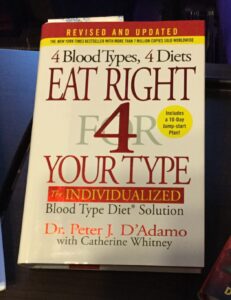
The food program known as “the blood type diet” has served as my foundation for what to eat since 1998. Eat Right for/4 Your Type by Dr. Peter J. D’Adamo with Catherine Whitney answered many of my questions about why certain foods and I didn’t get along. The general principle is that each blood type has a list of foods that are more helpful than others and by avoiding the harmful foods, the body stands a better chance of thriving. I highly recommend checking out the system.
As writers, we need the whole body to be in good working order because we need brain power to think, physical stamina to endure hours of sitting, and emotional stability to deal with the publishing industry. It’s a rough profession in some regards even though we can have a lengthy career if our bodies are healthy.
BRAIN FOOD
I’m simplifying things in the interest of expediency. The brain needs high levels of protein and healthy, plant-based fats to function. You can make soups with good broth bases such as tomato, vegetable, and low sodium animal proteins. If you want a creamy option, choose plant-derived ones like coconut or almond milk. Likewise, plant-derived oils like olive, avocado, and coconut are better for brain function.
Next, choose ingredients such as beans, vegetables, and leafy greens (kale, spinach, broccoli, cabbage) which are also heart healthy and add taste, texture, vitamins, minerals, and antioxidants to your diet.
Your brain needs a lot of protein. Lean meats like beef and chicken are ideal but go outside the kitchen box and try turkey, lamb, and fish for a change of pace. Since chicken is an avoid food in our family, I make every type of traditional chicken soups with lean, antibiotic free turkey instead.
Grains and flours are called for in many soup recipes. Checking my blood type, which is O, I cannot eat wheat, corn, or barley. No worries. I thicken our creamy soups with spelt flour and use spelt noodles instead of wheat. Tastes great!
Finally, soup needs herbs and spices for flavor and balance. Light amounts of salt is a given, but black pepper doesn’t agree with my blood type. A pinch of cayenne or red pepper flakes adds the perfect zing to my soups.
Here is one of my favorite soup recipes for healthy brains.
Spicy Roasted Butternut Squash and Sweet Potato Soup
Ingredients
1 medium butternut squash
2 medium sweet potatoes
3 heaping teaspoons minced garlic
4 cups of low sodium turkey broth
2 cups of almond or coconut milk
½ cup diced celery
½ cup diced white or yellow onion
2 tablespoons extra virgin olive oil
½ teaspoon pink salt
¾ teaspoon oregano
¾ teaspoon marjoram
1 teaspoon ground cumin
¼ or ½ teaspoon cayenne pepper
½ teaspoon red pepper flakes
1 cup of sour cream
Chopped parsley or cilantro
Chopped green onion
Instructions
Preheat the oven to 400 degrees.
Peel and dice the butternut squash and sweet potatoes. Smaller chunks bake faster.
Place the squash, sweet potatoes, garlic, celery, and onion in a large mixing bowl. Drizzle liberally with olive oil. Stir then add salt, oregano, marjoram, cumin, cayenne pepper, and red pepper flakes and stir, coating the vegetables thoroughly with oil and spices. Allow to marinate for five minutes.
Cover a large baking sheet with parchment paper and swirl olive oil in the center. Pour the marinated vegetables onto the parchment paper and spread evenly.
Bake at 400 degrees for 40-45 minutes (or less if the pieces are small). Check that the squash and potatoes are very soft before taking out of the oven.
In a large soup pot, heat a little more olive oil over medium heat. Add the roasted vegetables. Stir to heat evenly then remove from the stove.
Cool the vegetables slightly then puree in a blender, food processor, or with a handheld immersion blender by adding ¾ cups of turkey broth and two cups of roasted veggies in batches until all is smooth. Return to the original soup pot.
Allow puree to heat but not boil adding any remaining turkey broth. Add additional spices to taste. We like this soup spicy, so I’m always upping the herbs and spices.
Temper two cups of almond or coconut milk by adding ½ cup of hot puree to the milk to warm it and avoid curdling when you add it slowly to the pot. Stir the milk in thoroughly.
Temper the sour cream the same way and slowly add to the soup mixture. Allow to simmer gently.
Garnish with chopped parsley or cilantro and green onion.
Six servings.
I know I promised stew, so stew on this. Think of the food you eat as if it were a story or article you’re writing. Prepare your meals and snacks with good ingredients the same way you search for good ideas to write about. Your food program should have purpose and meaning like the stories you tell. Outline your food choices and eating habits in advance the same way you organize a piece of writing—both need a beginning, middle, and end. Preparation and planning always make for better writing and eating.
No boiling writers allowed.
What is your favorite snack for brain health and support?
Up next: Your Creativity on Auto Pilot
Be well, write well!
~Joy
Connect with me on Facebook, Twitter/X, and Instagram.
This article may contain affiliate links which may result in the author receiving a commission when readers purchase items through the links.
You are receiving this message because you previously signed up for notifications or participated in a program/course with Joy. You may unsubscribe at any time.
My ideas are not ever meant as a substitute for consulting with a qualified health professional.
Advertisement
My WriteDay Subscription Box
My WriteDay Subscription Box for writers is open for new subscribers. Join today to receive the May/June box “My Writing Coach” full of writerly goodies and healthy support for your creativity.
Buy me a coffee
JOY E. HELD is an author, educator, editor, entrepreneur, and literary citizen responsible for this site and its contents. She is the author of
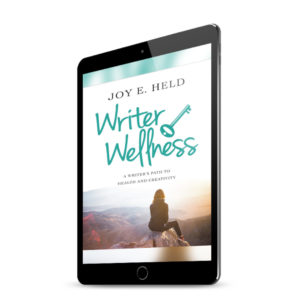
Writer Wellness: A Writer’s Path to Health and Creativity (Headline Books, Inc., 2020)
Writer Wellness Workbook: A Guided Workbook and Journal to Accompany Writer Wellness: A Writer’s Path to Health and Creativity (Headline Books, Inc., 2023)
The Mermaid Riot (Fire and Ice YA, 2024) Young Adult Historical Fantasy
She writes spicy historical fiction under a pen name.
She is the winner of multiple writing and book awards:
West Virginia Writers, Inc. Annual Writing Contest, Honorable Mention, Novel, 1998.
New York Book Festival, Honorable Mention, Writer Wellness, 2020.
Next Generation Indie Book Awards, Finalist, Writer Wellness, 2021.
Northeast Ohio Romance Writers of America, Member of the Year, 2020.
Northeast Ohio Romance Writers of America, First Book Award, 2020.
She is an adjunct faculty member in the Southern New Hampshire University Online MFA Creative Writing.
She is a proud graduate of Seton Hill University in Greensburg, PA with an MFA in Writing Popular Fiction.
She is a member of The Authors Guild and the Society of Children’s Book Writers and Illustrators.
Joy is the founder and CEO of My WRITEDAY Subscription Box for writers and readers.