GUEST POST: WHAT I DON’T DO AFTER FINISHING A ROUGH DRAFT

Friday 2 January 2026

“What I Don’t Do After Finishing a Rough Draft”

Guest post from author KAREN A. WYLE

I write rough drafts in a hurry. For many years I followed the original rules of National Novel
Writing Month, even after those rules loosened up: write at least 50,000 words of a new novel
entirely within the month of November. I would make notes on a few characters and some
possible scenes during October, and sometimes do a little research, but I saved starting the actual
text for November 1 st . That meant averaging 1,667 words a day, a pace which kept me from
spending hours editing and fretting over what I’d already written. In recent years I’ve allowed
myself to start in late October, but I still aim to reach (and usually pass) the 50,000 word mark by
the end of November. More often, November 30 th or the first few days of December find me with
a very rough draft about 55K-65K words long.

Very rough. Typical problems include inconsistent character descriptions, inconsistent plot
developments, unheralded changes in point of view or character descriptions, characters
introduced early on who vanish for the rest of the book, and characters with identical names. I’ve
even had characters come back from the dead, with no intention or fanfare. Promised or
foreshadowed plot events may never materialize. On a more technical level, there are often too
many filler words such as “very,” “quite,” “somewhat,” “almost,” “feel,” and (in some uses)
“that.” These words create unnecessary distance between the reader and the point of view
character, or dilute the impact of what’s happening. Two or three or more characters may also
have identical speech habits and vocabularies, instead of their “voices” reflecting their
geographical origins, educational levels, and personalities.

So I jump right into fixing all these problems once the draft is finished – yes?

Well, no. I’ve found it’s better to wait a few weeks and approach the draft with fresh eyes. The
closer I can come to experiencing the draft as a reader instead of a writer, the better my chances
of seeing these problems. Then I can put my writer hat back on and start solving them. I can also
see where the story is too thin, where it needs a deeper dive into a character’s motivations or
trauma, where a subplot could add interest or an existing one is pointless or distracting. And I
can see whether the parts of the story that should move me as a reader actually do so.

It’s not always easy to step back after a month of working on the draft every day. There’s no
feeling quite like the creative impulse on simmer, the way my subconscious sneaks in and turns
the heat up so that it boils at 2 a.m. and compels me to scribble down a barely legible idea on my
bedside note pad. But I know, by now, that if I want the book to be good in the end, it needs this
fallow time.

KAREN E. WYLE

Karen A. Wyle is a retired appellate attorney and the author of multiple novels in a bewildering array of genres.  She has been married more than thirty-six years and has two wildly creative adult offspring. She lives between two small dots on the map in south central Indiana, more or less in the woods. http://www.KarenAWyle.com


Disclaimer

This article may contain affiliate links which may result in the author receiving a commission when readers purchase items through the links.

You are receiving this message because you previously signed up for notifications or participated in a program/course with Joy. You may unsubscribe at any time.


Advertisement


Buy me a coffee

GUEST POST: THE IMPORTANCE OF BACKSTORY TO WRITING

22 September 2025

“The Importance of Backstory to Writing”

Guest Post from Author PETE TAYLOR

Some trail names are given to hikers by their fellow hikers. Trail names generally reflect a personal aspect of a hiker such as hair color, appearance, profession, and a myriad of other aspects of a person.

We always laugh about a guy we met with a trail name of “Ass Trumpet.” At one of the first town-stops along the trail he overdid the salad and fruit bar one night and for the rest of his time on the trail he was called “Ass Trumpet” after keeping his fellow hikers up all night with his ‘explosions.’

A trail name sticks with you. It sometimes pops up years after the end of a hike. For example, I was in a small outfitters shop in Luray, Virginia looking for a specific piece of hiking gear for my son’s Christmas present. A guy tapped me on the shoulder and asked, “Hardcharger”?

I turned and sure enough it was “Red Dawn,” a young man I had hiked with back in Tennessee many years before. To this day I doubt if either of us remembers their real name, but we recognized each other and chatted for a while catching up on our hiking experiences. In another incident, in a shelter in Connecticut, I ran into a young woman who told us her trail name. I had seen that name in a trail log in one of the shelters in Virginia. She was a member of a group of young women who referred to themselves as the “Pack Divas.” I asked her what had happened to her group, and we had a wonderful time talking around the campfire.

Hiking serves as the backstory, the backbone so to speak, using the hike as an extension to support the central theme of my books Province Senior Intelligence Advisor and The Tuscarora Trail, part of my four-book series set during the Vietnam War. This backstory also serves as a metaphor for facing the challenges of life, overcoming obstacles, and learning to move on from adversity.

Besides the retelling of my Vietnam experiences, I added nuance to the events by relying on my own trail journals that I’ve kept for all of my hikes. Each night I’d sit and jot down notes about the day. When I got home, I’d get out maps and expand on the works by recording the daily mileages, proper geographical names, names of people and places we had encountered, and include photos that I had taken. I’d type them up into a web file and store them away.

Hardcharger & Johnny B on the Appalachian Trail

“Johnny B” and I have been hiking together for thirty years, and we’ve lived a number of adventures. My journals from those hikes make for great ‘backstory’ for my books.

The ‘backstory’ gave me a great opportunity to have a ‘vehicle’ to tell the various war stories as if I am talking to an audience rather than just relating the stories in machinegun fashion. In the final book of the series, The Tuscarora Trail, I was able to use the hiking backstory to finish the series as well as to weave a degree of closure into the stories. My intent was to have a ‘backstory’ that people could relate to.

So how does a writer convey those feelings; fear, loneliness, frustration, quick-learning, and still tell the story? Part of the ‘success’ is the backstory. Be it the Appalachian or Tuscarora Trails, or an innocent romance, backstory is important to my writing. It provides an additional vehicle to tell other parts of the events and to develop or maintain interest in the major theme of my books. The story-in-the-story is helpful because the ‘hero’ can show additional character dimensions that wouldn’t necessarily be observable in the standard telling of the tale; love in wartime, coming-of-age, adventurous hikes, feelings of grief and loss, and a myriad of other emotions that can be explored by the reader and the author alike all through backstory.

Have a good one,

~Pete

AUTHOR BIO PETE TAYLOR

Peter Taylor is an American author and Military Historian who served three combat tours in Vietnam 1969-1971 and 1972-1973. His works include a Civil War History of Harrison County, West Virginia, a novel that developed from that book The Most Hated Man in Clarksburg, and The Advisor Series, four novels about the military Advisory efforts in Vietnam.

*Thanks for your wisdom and your service, Pete. ~JEH


DISCLAIMER

This article may contain affiliate links which may result in the author receiving a commission when readers purchase items through the links.

You are receiving this message because you previously signed up for notifications or participated in a program/course with Joy. You may unsubscribe at any time.


Leave a comment below.


ADVERTISEMENT


Buy me a coffee


GUEST POST: EXPLORING THE STORY THAT CAME BEFORE THE STORY BY LYNN SLAUGHTER

GUEST POST: EXPLORING THE STORY THAT CAME BEFORE THE STORY BY LYNN SLAUGHTER

Missing Mom by Lynn Slaughter

Saturday 2 August 2025


I’ve long been fascinated by real-life mysteries of missing persons, people who suddenly disappeared from their loved ones’ lives. So many questions, and often, so few answers. Were they victims of foul play? Kidnapped? Running from something? Running toward something that they found more appealing than their current lives? So many possibilities, and for loved ones left behind, so much grief and uncertainty.

Given my interest in missing persons’ cases, I guess it’s not surprising that I decided to explore what happens to someone left behind. Thus was born the premise for my latest novel, MISSING MOM, in which Noelle, a seventeen-year-old, is distraught over her mother’s sudden disappearance. Despite the circumstantial evidence, she doesn’t believe that her mother would ever have committed suicide and is determined to unravel the mystery of what happened to her mom.

As writers, we often talk about the importance of digging into the backstories of our characters to understand their choices and reactions. Why, for example, is Noelle so sure her mother did not commit suicide? The answer lies in her unusually close relationship to her mother who is such a great listener and so supportive that even Noelle’s friends flock to her mom for advice and counsel. On the day she went missing, Noelle’s mother had made plans to go out with her daughters to the mall for school shopping and pizza. The idea of her mom deciding, “Never mind shopping and pizza. Now I’m going to kill myself” makes absolutely no sense to Noelle.

So, what did happen to her mother? The mystery turns out to be related to the saga of a young woman nearly twenty years earlier who managed to escape from an abusive marriage. I found this young woman’s story riveting and decided to thread it throughout the novel.

After I’d written MISSING MOM, I discovered that what I had done is called a “time slip novel,” in which interconnected stories from different time periods appear. Although time slip novels are not uncommon, this marked the first time I’d ever attempted one, and I found it exciting to try something that was new for me as a writer.

All in all, I loved exploring the story that came before the story I set out to tell. Sometimes our curiosity takes us into new and unexpected places, which makes writing and reading especially pleasurable.


BIO:

Lynn Slaughter is addicted to the arts, chocolate, and her husband’s cooking. After a long career as a professional dancer and dance educator, she returned to school to earn her MFA in Writing Popular Fiction from Seton Hill University. Her six published novels have received numerous accolades, including a Silver Falchion Award, an Agatha nomination, an Imadjinn Award, and a Moonbeam Silver Medal. Midwest Book Review called her most recent work, Missing Mom, a “remarkable book” that “invites readers to immerse themselves in a narrative that beautifully captures the essence of struggle and triumph.”

Lynn’s website: https://lynnslaughter.com

Purchase links for MISSING MOM:

Amazon
Barnes & Noble


Advertisements

Perfect Strangers by Barbara Jean Miller

Click on the image to purchase.

The Mermaid Riot by Joy E. Held
Click on the image to purchase.
My WriteDay Subscription Box

This article may contain affiliate links which may result in the author receiving a commission when readers purchase items through the links. Thank you for your support.


GUEST POST: 3 ERRORS THAT LED TO MY SMALL PRESS CONTRACT BY JEAN BURGESS

Tuesday 1 July 2025

3 Errors That Led to My Small Press Contract
Jean Burgess, Ph.D.

If you’re a “full steam ahead” type, who is too impatient to learn from your mistakes, then stop reading now. However, if you are willing to learn how, as a novice fiction writer, I made a few major errors and still landed a contract with a small press for my debut fiction, read on.

As writers, we tend to get so excited when we finish our manuscript that we just can’t wait to push it out into the world. Some writers want to skimp on steps like beta readers or competent development editing. Some are tempted by visions of dollar signs, then movie deals, then television series, then world domination…(See how quickly things can spin out of control?)  And sadly, some have lost their grounding and forgotten why they were drawn to writing in the first place.

I can point out these flaws because I’ve been there. Let’s dive in and see what can be learned from these errors.

Error #1: Pitching to literary agents before the manuscript is ready

Yep, that was me. The book was completed. Several beta readers offered input and I made a few edits based on their feedback. I thought I’d caught all the grammar goofs and typos. I decided I was ready to secure a literary agent. So, I queried and queried and queried. I received plenty of “Thanks, but no thanks” responses.

I also pitched at writing conferences. That was a better experience because, after submitting my three chapters or fifty pages, at least I received a few “Thanks but no thanks and here are two reasons why… .”

With something to work with, I was able to make revisions…badly needed revisions.

Lesson learned: The feedback I received from the literary agents was invaluable for me because it pointed to developmental issues. It caused me to ask: How do I fix those issues? As a novice fiction writer, I was able to analyze my skill weaknesses. I took workshops and classes to strengthen the holes. The biggest lesson, however, was I needed to be prepared and open to revising (and revising and revising) my manuscript. I learned that hiring a development editor BEFORE copy editing is an important step.

Error #2: Being uneducated about the industry

Guilty as charged. Looking back on my own journey, I now ask myself, “What was I doing querying agents when I didn’t understand a thing about the author-agent relationship?”

What did I want from a literary agent? Did I even understand their function in the industry and what they do for authors? And what about self-publishing vs traditional publishing? What was that hybrid publishing I kept hearing about? How can I avoid scams? Yikes! I realized I needed to get myself educated.

Lesson learned: While there are a variety of paths to getting these questions answered, I chose to join several professional writers’ organizations. These offer seminars and resources that help me immeasurably, plus I appreciate the networking aspect of the groups. I also encourage others to read reputable blogs, join podcasts, and find other resources about the industry. Jane Friedman’s blog, Writer’s Digest, Authors Publish online magazine, and this one are just a few examples. Secure a complete understanding of all the various publishing approaches — self-publishing vs traditional publishing vs small press publishing – before deciding which is right for you and your book.

Error #3: Not having a clear writer’s purpose

I do believe that not being clear about my writer’s purpose when I took the next step in promoting my book, whether querying a lit agent or even chatting about it to readers, was a huge obstacle. It interfered with my messaging and my confidence.

When I say, “writer’s purpose,” I’m not talking about my reason for writing this particular book, but rather for writing anything. What motivates one to write? And if your answer is “For the big bucks,” you might want to dig a bit deeper!

I found that I was flailing with connecting to my purpose, which caused me to be unfocused when I spoke about my debut novel.

Lesson learned: Once I permitted myself to indulge in uninterrupted quiet reflection on the question “What motivates me to write? What is my purpose?”, I finally found clarity. My writing purpose applies to both my nonfiction and fiction works:

I write to encourage others and to start conversations.

Understanding and connecting with this purpose has helped me to define my goals and decisions moving forward. I pivoted my thinking and decided to put all my efforts into pursuing small presses for publication of my debut novel set in the late 1970s around themes of emerging feminism, social injustice, and retro music. As a result, at the next regional writers’ conference I attended, I skipped pitching to the literary agents on the roster and focused on the small press publishers instead.

In the past, regardless of whom I pitched to, I must admit I’d be anxious about the whole process. But once I was grounded in my writer’s purpose, I found enjoyed pitching. I was relaxed as I chatted about my book and its marketing possibilities.

The best news of all is that my debut novel, That Summer She Found Her Voice, was picked up by Apprentice House Press and published in April of 2024. Based on my journey of being open to revisions, learning all I could about the industry, and taking time out to define my personal writing purpose, I encourage you to apply these vital steps toward securing your own publishing success story. Best wishes.

Jean Burgess, Ph.D. is a writer, editor, and playwright with a background in theatre and education. She holds a M.A. in Theatre from Northwestern University, and a Ph.D. in Educational Theatre from New York University. Her debut novel, That Summer She Found Her Voice: A Retro Novel, was published by Apprentice House Press in April 2024 and is available on Amazon and other online outlets. Follow her publishing journey by signing up for her monthly newsletter at https://www.jeanburgessauthor.com.


Advertisements

Perfect Strangers by Barbara Jean Miller


GUEST POST: “Writing for Your Life” by LINDA BALLOU


This article may contain affiliate links which may result in the author receiving a commission when readers purchase items through the links.


“Writing for Your Life”

Guest Post By Linda Ballou


My writing is not just a rewarding creative expression that some would consider an indulgence. It was my way of sorting out who I was, a healing mechanism and a way to cope with the challenges that came my way.  At the tender age of thirteen, I was rudely uprooted and transplanted in Haines, Alaska, a tiny town at the top of the Inside Passage. I remember our excitement at seeing a Mama Moose with a calf clomping across the road that runs through the Chilkat River Valley when we arrived at our new home. The river valley teeming with wildlife remains one of the most beautiful places I’ve seen on the planet.

Still, I was the new girl in town and plainly out of step with my peers. I turned to books in my isolation. I began to journal to help me deal with my loneliness. Reading, The Second Sex, by Simone De Beauvoir got me thinking about women’s roles in society. I wasn’t burning my bra in the streets, but I was questioning whether I wanted marriage and children.

As Isabella Bird so famously said,

” If you want to be a vine around a tree, then marry.”

When I turned 18 I returned to California to attend college in Los Angeles. Once again, I didn’t fit in. The drug -culture was in full swing and I found getting stoned boring. I put myself through college selling real estate. I earned a degree in English Literature and graduated exhausted and disillusioned with the materialistic society I was living in. I dropped out of society and landed on the North Shore of Kauai to think about it all and test my writing ability

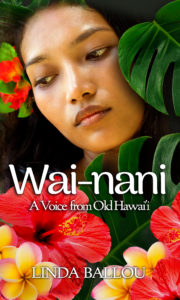
It was here that I met the heroine of my first novel Wai-nani: A Voice from Old Hawai’i. Ka’ahumanu, the favorite wife (out of 32) of Kamehameha the Great, is a controversial character in Hawaiian history. She was a childless bride who became his confident and companion. When he died he bestowed upon her the power to rule with his son. She was a magnificent athlete, brave, passionate, and caring, dubbed the “Mother of the People”. She embodied the empowered, self-actualized woman that I so admired and wanted to become.

Publishing Wai-nani was a monumental step forward in my writing life. I had to be brave like Ka’ahumanu and lift the dragon’s tail of fear from my path. It meant taking the risk of failure and possible rebuke from Hawaiian scholars. It moved me towards personal liberation and believing in myself as a writer. It required taking responsibility for having a voice and becoming part of the “Long Conversation”.

I returned to California where I supported my eating habit by selling real estate. I took up horseback riding and ended up hook line and sinker into the sport. My mare was my best friend. We rode the hills and dales around our barn entered jumping events and became a team. One day while riding her I felt a tingle in my lower back. The next day I was down for the count with a herniated disk. I was forced to give up my Gingersnap and the riding world.

The nerve pain was mind-bending, but the thought of losing my mare and the horse world I was so invested in was devastating. I couldn’t sit for any length of time, so I stood at my breakfast bar to write The Cowgirl Jumped Over the Moon. Being engaged in writing the story took my attention away from the nagging sciatic pain in my legs.

My protagonist does everything I ever wanted to do on a horse. She even rides solo on the Pacific Crest Trail which was a dream of mine. There she meets a lone cowboy who is a fire lookout. Rugged, yet sophisticated, caring, and a good cook he is my fantasy guy. There is also an environmental message about not disturbing the natural world that became important to me when I was growing up in Alaska. So, writing this story helped me let go of Ginger and allowed me to give voice to things I care about.

Eventually, I healed. I put the love of horseback riding, writing, and travel into play as a travel writer. For the past couple of decades, I have enjoyed traveling around the globe hosted by various outfitters. My writing has taken me where I needed to go.

When the pandemic set in for the kill my travel wings were clipped. At first, I was angry about not being able to continue the life I loved, but once again my writing saved my life. Isabella Bird was an intrepid, Victorian Age explorer who ventured to parts of the world where they had never seen a white woman. I had long admired her pluck and writing skills. I determined to fictionalize her life and times in Hawai’i and Colorado. The result, Embrace of the Wild, was featured on the BBC docuseries Trailblazers that aired in the U.K. in 2022. Writing this book got me through two years of isolation, and brought wonderful new exposure to my work.

In retrospect, I see how my writing has been my coping mechanism, a means of fulfillment, and a form of self-actualization.  Lost Angel Unleashed, the third book in my Lost Angel Travel Trilogy, released in 2023 is a travel memoir. I share my lonesome beginnings with humor along with some of my favorite travel memories. I think it is a wrap, but you never know, I may need to write one more book to stay alive.

www.LindaBallouAuthor.com


Advertisements