“EUSTRESS TOOL KIT” TO HELP YOU RELAX

RELAXATION FOR WRITERS

25 April 2025
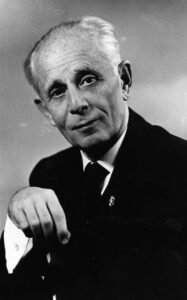
Hans Selye

A researcher named Hans Selye began ground-breaking studies in the 1930’s on stress. Since then, we’ve been educated on the detrimental effects of stress on our mind-body-spirit system. Stress is bad has and is the message, but Selye was among the first to define eustress or conditions that are productive and healthy for the body. Distress=negative situations. Eustress=positive impacts. Like the feeling of euphoria, eustress represents life events such as achieving a goal, going on vacation, getting a good evaluation, or doing something you enjoy. Stress is unavoidable and always has been. From the first time a saber-toothed tiger chased a primitive hunter out of the forest, stress has and will continue to be a part of the life and development of humankind. And writers. I could end it here by saying, “Just deal with it,” but that wouldn’t be helpful. What I am going to suggest is reframing your relationship with (di)stress to achieve a balanced acceptance of it in your life and work as a writer.

TIME CANNOT BE MANAGED

One of the biggest lessons I have learned from 50 years of practicing yoga and meditation is that time cannot be managed. It can only be accepted. Not changed, reversed, challenged, or revisited. Time is in control, and it is life altering to accept that and not constantly be at war with it. I learned this from the simple practice of counting my breaths and noticing how Time became not the enemy or friend but my steady companion. Time is the constant. We are not. Even though Time is a man-made concept, I believe that it is the source of much of our (di)stress. Reframing my perception of Time as simply a construct rather than a master was very relaxing. This is what I mean by revising your impression of stress to something more positive.

STRESS CANNOT BE MANAGED

Time cannot be managed regardless of how happy your planner or appointment app may be. It will march forward with or without you and not be impressed by whether you keep up or not. So why let it manage YOU? I believe the same about managing stress. It is a fact of life and cannot be “managed” any easier than time can be. Both concepts can be ORGANIZED but not managed. Imagine the faces on my students the first day of the “Stress Management” college course I taught for years when I explained my perspective on time and stress. Neither is manageable but you can rethink your view and achieve understanding, balance, and relief by accepting this and learning to COPE.

“EUSTRESS TOOL KIT”

1.The first step is acknowledging your place in the hierarchy of stress and time. You are not in control but that doesn’t mean you can’t play well with them.

2.The second step is creating a list of what you already know helps you relax. From the simple to the complicated and the mundane, making a list of what you find relaxing provides you with a tool kit for accepting what you can’t change and believing that life will be okay. This is your “Eustress Tool Kit.”

3.Third step is practicing the actions on your personal relaxation list on a daily basis. At least one relaxing activity per day will help you achieve balance and develop the understanding that you can handle almost anything because you know that stressful situations happen and that you have a set of tools to help you cope.

My “Eustress Tool Kit” list includes:

Walking

Yoga

Counting breaths

Gardening

Meditation

Reading

Water

Journaling

Butterflies

A day without appointments

Purple things

Colored markers

Helping people

Learning something new

The sound of my grandson’s voice

Blank paper

Not burning what I’m cooking or baking

Laughing

Thinking

Sharing

What’s in your “Eustress Tool Kit” that you can pull out once or twice a day to cope with stress instead of fighting with it?
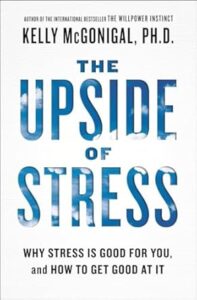
If you want to look deeper at this idea, I highly recommend reading The Upside of Stress, Why Stress is Good for You, and How to Get Good at It by Kelly McGonigal (Penguin Random House, 2015).

Up Next: Eat Right to Write Right


Sign up for my weekly e-newsletter by filling out the form below. Thanks in advance!


Be well, write well.

~Joy

This article may contain affiliate links which may result in the author receiving a commission when readers purchase items through the links.
 

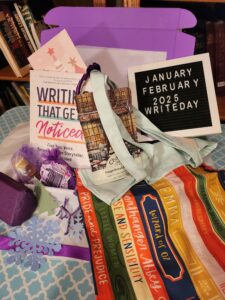
MY WRITEDAY SUBSCRIPTION BOX CART OPENS MONDAY, MAY 5. Don’t miss out on this fun box of writerly goodness lovingly called by one subscriber “A treasure trove for writers.” The May/June box is called “My Writing Coach.”


Buy me a coffee


REGULAR EXERCISE IS THE EQUIVALENT OF “MIRACLE GRO” ™ FOR YOUR BRAIN

REGULAR EXERCISE IS THE EQUIVALENT OF “MIRACLE GRO” ™ FOR YOUR BRAIN

19 April 2025

Exercise. We either love it or hate it, but we all know that some form of physical activity on a daily basis is part of a healthy routine and promises a balanced lifestyle, reduced stress levels, and longevity. Sometimes it can be a challenge to workout because life and schedules get in the way. Regular exercise doesn’t have to be time consuming or exhausting. Working in short bursts of movement throughout the day is better than nothing at all. On days when you have more time, exert more effort to exercise in concentrated amounts of time. Consider this sample exercise schedule for busy people.

1.Plan to exercise for 10 minutes three times a day. Choose from these examples,

  • walk
  • work with small hand weights
  • work with a treadmill or other exercise equipment
  • pedal exerciser (under-desk-bike)
  • do some stretching

Better yet, be active in a variety of ways throughout the day to keep boredom at bay. Yard work counts!

2.Group exercise classes that are regularly scheduled can be very motivational but are not always practical. Spend a few minutes researching and bookmarking exercise videos on the internet. There are tons for free. Once a week, prioritize time to exercise with a video. If it is more than ten minutes long, that’s okay. Do the first ten minutes only, which should be the warm-up portion, if that’s all you can work into your schedule.

3.While books about exercise don’t offer the benefit of having a knowledgeable instructor nearby to offer tips for safety and modification, they are a great source of information.

4.Put exercise on your list of things to do every week. Just writing it down will remind you to do it and make you feel accomplished when you can check if off the list.

Physical exercise is not just about keeping the body in shape. The mind-body-spirit connection is a real thing and has been proven by studies to deliver overall health benefits.

In his book Spark: The Revolutionary New Science of Exercise and the Brain, Dr. John J. Ratey offers amazing details about how exercise supports thinking while keeping the physical container in working order. For the sake of simplicity and understanding, Ratey reported that the discovery of a protein factor found in the brain called brain-derived neurotrophic factor (BDNF) is responsible for the growth of new cells, especially those required for learning. BDNF is manufactured in the brain only. There is no pill form of it. What stimulates the production and hence the new brain cells is the connection between the protein and physical activity. Exercise propels BDNF for what Ratey calls “Miracle-Gro for the brain” (40). Studies since Ratey’s report have expanded on this principle and evidence proves that exercise strengthens not only our physical bodies but also develops our brains. Throughout the life span.

Here are a couple of questions about your physical fitness program if you care to post a comment!

Exercise question #1: Describe your current exercise routine explaining what you do and how often.

Exercise question #2: Are you satisfied with your current exercise routine? Why or why not?

Up Next: Quick and easy relaxation techniques.

Sign up for my weekly e-newsletter by filling out the form below. Thanks in advance!

Be well, write well.

~Joy


MY WRITEDAY SUBSCRIPTION BOX CART OPENS MONDAY, MAY 5. Don’t miss out on this fun box of writerly goodness lovingly called by one subscriber “A treasure trove for writers.” The May/June box is called “My Writing Coach.”
“Miracle-Gro” ™ is a registered trademark of OMS Investments, Inc.

Work Cited

Ratey, John J., M.D. Spark: The Revolutionary New Science of Exercise and the Brain. Little, Brown, and Company, 2008.


This article may contain affiliate links which may result in the author receiving a commission when readers purchase items through the links.

You are receiving this message because you previously signed up for notifications or participated in a program/course with Joy. You may unsubscribe at any time.


Advertisement

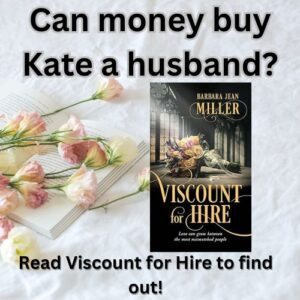
The wealthy Kate Hamilton must marry the wounded viscount she is sheltering in her London townhouse since saving his life has ruined her. But he is a perfect candidate since he needs to marry well. When he seems reluctant, Kate proposes hiring him as her husband to disguise her love for him.

Hugh Bartram, Viscount of Dancy, has never met anyone like levelheaded Kate, thrusting herself into a scandal to save his sister from gossip. He resents Kate trying to solve everything with money, even as he admits her heart is in the right place.

Just as they wed, his sister elopes, and Dancy is captivated by the unconventional Kate as they ride across England together to prevent another scandal.


Buy me a coffee:)


JOY E. HELD is an author, educator, editor, entrepreneur, and literary citizen responsible for this site and its contents. She is the author of
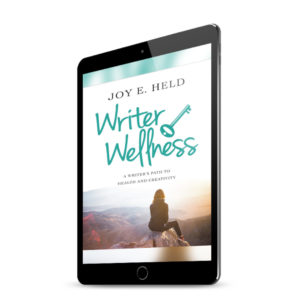
Writer Wellness: A Writer’s Path to Health and Creativity (Headline Books, Inc., 2020)
Writer Wellness Workbook: A Guided Workbook and Journal to Accompany Writer Wellness: A Writer’s Path to Health and Creativity (Headline Books, Inc., 2023)
The Mermaid Riot (Fire and Ice YA, 2024) Young Adult Historical Fantasy
She writes spicy historical fiction under a pen name.
She is the winner of multiple writing and book awards:
West Virginia Writers, Inc. Annual Writing Contest, Honorable Mention, Novel, 1998.
New York Book Festival, Honorable Mention, Writer Wellness, 2020.
Next Generation Indie Book Awards, Finalist, Writer Wellness, 2021.
Northeast Ohio Romance Writers of America, Member of the Year, 2020.
Northeast Ohio Romance Writers of America, First Book Award, 2020.
She is an adjunct faculty member in the Southern New Hampshire University Online MFA Creative Writing.
She is a proud graduate of Seton Hill University in Greensburg, PA with an MFA in Writing Popular Fiction.
She is a member of The Authors Guild and the Society of Children’s Book Writers and Illustrators.
Joy is the founder and CEO of My WRITEDAY Subscription Box for writers and readers.


JOURNAL-TO-GO-BAG SHAKES THINGS UP IN A GOOD WAY

JOURNAL-TO-GO-BAG SHAKES THINGS UP IN A GOOD WAY

12 April 2025

To refresh your memory, my author platform for over 30 years has been the health and well-being of creative people, especially writers. Writer Wellness: A Writer’s Path to Health and Creativity was my first published book in 2003 after several years of presenting workshops on the topic. The book is in its third edition and with a third publisher because the previous hosts closed up shop. Publishing is a chaotic business and not for the faint of heart or the impatient. Writer wellness is a way to embrace and thrive within the chaos.

The five key concepts of writer wellness are journaling, exercise, relaxation, nutrition, and creative play. As publishing and authoring evolve, I like to regularly remind creatives to follow good self-care practices in order to support their work and health. This post includes tips for journaling.

JOURNALING

Everyone goes through a journaling slump. Regardless of dedication to the practice, it can become stale or mundane. It happens. Don’t take it as a sign of time to stop. A journaling slump is time to explore the page beyond the norms. Instead of documenting the events of the day, write the list in your journal and title it “Today’s Goals” then check everything off with an X or a check mark. This is a positive way to look at a repeat practice.

Another helpful activity is to change up the place where you journal. I regularly like to go to a coffee shop or the library to journal to shake up my surroundings and what I journal about. One thing I do is LEAVE MY JOURNAL AT HOME and take blank paper to the new spot. I do this because I don’t want my regular journal to be misplaced. Once I’m home, I staple, glue, or enclose the pages in a cellophane envelope and add stickers then attach the whole thing to a page in the regular journal.

“Journal-to-Go-Bag” is a must and makes journaling in a new place easy. Fill a tote with the essentials such as blank paper or a notebook, pens, and markers and keep it always ready to go. I also include a roll or two of washi tape in case I find ephemera or interesting things at the location to add to my pages.

Up Next: Taking care of your physical body with regular exercise keeps your brain in shape too!

Sign up for my weekly e-newsletter by filling out the form HERE. Or scroll to the bottom of this page! Thanks in advance!

NEWSLETTER

Be well, write well.

~Joy


MY WRITEDAY SUBSCRIPTION BOX CART OPENS MONDAY, MAY 5. Don’t miss out on this fun box of writerly goodness lovingly called by one subscriber “A treasure trove for writers.” The May/June box is called “The Writing Coach.”


Advertisement

The wealthy Kate Hamilton must marry the wounded viscount she is sheltering in her London townhouse since saving his life has ruined her. But he is a perfect candidate since he needs to marry well. When he seems reluctant, Kate proposes hiring him as her husband to disguise her love for him.

Hugh Bartram, Viscount of Dancy, has never met anyone like levelheaded Kate, thrusting herself into a scandal to save his sister from gossip. He resents Kate trying to solve everything with money, even as he admits her heart is in the right place.

Just as they wed, his sister elopes, and Dancy is captivated by the unconventional Kate as they ride across England together to prevent another scandal.


This article may contain affiliate links which may result in the author receiving a commission when readers purchase items through the links.

You are receiving this message because you previously signed up for notifications or participated in a program/course with Joy. You may unsubscribe at any time.


JOY E. HELD is an author, educator, editor, entrepreneur, and literary citizen responsible for this site and its contents. She is the author of

Writer Wellness: A Writer’s Path to Health and Creativity (Headline Books, Inc., 2020)

Writer Wellness Workbook: A Guided Workbook and Journal to Accompany Writer Wellness: A Writer’s Path to Health and Creativity (Headline Books, Inc., 2023)

The Mermaid Riot (Fire and Ice YA, 2024) Young Adult Historical Fantasy

She writes spicy historical fiction under a pen name.

She is the winner of multiple writing and book awards:

West Virginia Writers, Inc. Annual Writing Contest, Honorable Mention, Novel, 1998.

New York Book Festival, Honorable Mention, Writer Wellness, 2020.

Next Generation Indie Book Awards, Finalist, Writer Wellness, 2021.

Northeast Ohio Romance Writers of America, Member of the Year, 2020.

Northeast Ohio Romance Writers of America, First Book Award, 2020.

She is an adjunct faculty member in the Southern New Hampshire University Online MFA Creative Writing.

She is a proud graduate of Seton Hill University in Greensburg, PA with an MFA in Writing Popular Fiction.

She is a member of The Authors Guild and the Society of Children’s Book Writers and Illustrators.

Joy is the founder and CEO of My WRITEDAY Subscription Box for writers and readers.


GUEST POST FROM AUTHOR VALERIE NIEMAN

GUEST POST FROM AUTHOR VALERIE NIEMAN

Saturday, 5 April 2025

Welcome historical fiction author Valerie Nieman with a fascinating perspective on researching for her novels.

Tracing Flickering Lights in the Dark

Not so long ago, most of us were putting away the strings of Christmas lights, hoping we won’t find a tangle when we open the bin again come November. That never seems to happen – somehow, the sets manage to knot themselves and cannot be easily pulled into the neat linear strings we expect. Where did all this complication come from?

It can be a bit like that, researching historical fiction. We expect to find a more or less continuous story, a reasonable thread of action and consequences, but history is more tangled than we think. Conspiracy theories aside, the reasons for an incident are often less than clear, people’s motivations are complicated, and people (or nations) may act in unreasonable ways. And history, as we know, is told by the victors.

I began working on my first historical fiction novel, Upon the Corner of the Moon, 30 years ago. People are shocked to learn that! Now I haven’t been writing continuously for three decades, but I have been working. Lots of reading, spells of writing, then back to research. As I was drafting and redrafting, I spent time writing other books – five novels, three books of poetry, a college history. I also went to Scotland on two month-long trips to hike, visit historic sites and museums, and generally “get the lay of the land.”

In this age of “instant art and writing” from AI, the thought of spending a third of a lifetime on one project seems a bit – obsessive. And it is. I came onto the story of the historical Macbeth while researching another book and was intrigued at how my favorite play had completely twisted the story. When I plunged into research for a novel on this topic, I didn’t imagine how deep that rabbit hole could go.

Those working in recent (20th century) historical fiction or studying well-documented eras have the benefit of newspapers, government records, previous histories– but in the more ancient past, records may be few or fragmentary, and they can be severely slanted because of religious or political considerations. Shakespeare based his play on Holinshed’s Chronicles, itself a compilation of earlier chronicles. At each iteration, legends became attached to history, cultural misunderstandings were amplified, and the actual Macbeths were slandered so that the current ruling dynasty might plump up its lineage.

I read original sources such as the “Life of St. Columba” by Adomnan, medieval handbooks of penance, an 18th century survey of the province of Moray that detailed the landscape of my book. I read sagas from the Norse and Danes, which provided some meat but also a lot of gristle: Names are replaced with epithets, dates might not match up, and the details of battles – well, remember that these were composed to glorify the jarl.

Scholarly sources were of great help in understanding the political landscape of northern Europe, from the Cnut’s Great North Sea Empire to the shifting Anglo-Saxon kingdoms. Scotland itself was not united into roughly the form we expect until the early 11th century, under Malcolm II, who welded Strathclyde and Lothian to Alba, and his grandson Macbeth who solidified this realm. The Western Isles remained under control of the Norse, and Orkney was an independent kingdom claiming parts of the north (Caithness).

I also read a lot of books on ancient matriarchal religions and guides to Pictish symbol stones and Celtic runes.

Secondary sources, from popular books to deeply scholarly analyses, were important in helping me untangle the chain of events that led to Macbeth’s death and the change from old Celtic patterns of kingship to primogeniture. That’s why the second book is titled The Last Highland King, because after Macbeth, Scottish rulers were highly Anglicized and connected to the lowlands.

Ultimately, I had to make decisions between competing sources. Was this man a nephew, or an uncle? Did this battle occur in 1054 or 1057? Some recent works invaluable in sorting wheat from tares included Macbeth Before Shakespeare by Benjamin Hudson, Picts: Scourge of Rome, Rulers of the North by Gordon Noble and Nicholas Evans, and The Wolf Age by Tore Skeie.

Research is like that pile of twinkling lights – you see the glimmers, study how the knots have formed, and with patience and some good advice, make a tangle into something that can illuminate the dark.

Thank you, Valerie!

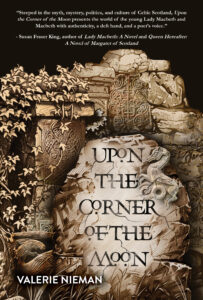
BOOK: Upon the Corner of the Moon

AUTHOR: Valerie Nieman

GENRE: Historical Fiction

BLURB:  At the dawn of the second millennium, two royal Scottish children are swept away from their families—Macbeth to the perilous royal court of his grandfather, Gruach to the remnants of the goddess-worshiping Picts. Macbeth learns that blood bonds are easily severed while Gruach finds her path only to lose it when she’s summoned back to the patriarchal world. They struggle with gaining and losing power, guided and misguided by prophecy and politics as their paths converge in a fiery bid for royal succession. Upon the Corner of the Moon separates literary legend from the reality of rulers who changed the face of Scotland. While closely following recorded history about Macbeth, it also speculates on the heritage of his wife Gruach, drawing on the Neolithic settlement of Alba and the mysterious legacy of the Picts. “Upon the Corner of the Moon is a haunting and bloody tale of Scottish history. It’s also a finger tracing along a set of scars, ones we already know are too deep to ever really heal,” said the Pittsburgh Post-Gazette.

ABOUT THE AUTHOR: Valerie Nieman’s debut historical novel, Upon the Corner of the Moon, is the story of the young Macbeths, destined to unite Scotland in the tumultuous 11th century. To learn more about the people and landscapes, she wandered Scotland from coast to coast and spent many happy hours in museums, libraries, and small pubs. She is the author of a short fiction collection, three poetry books, and six other novels, including In the Lonely Backwater, winner of the 2022 Sir Walter Raleigh Award, which was called “not only a page-turning thriller but also a complex psychological portrait of a young woman dealing with guilt, betrayal, and secrecy.” Her novel Blood Clay won the Eric Hoffer Prize in General Fiction. To the Bones, a horror/Appalachian/ecojustice novel, was a finalist for the 2020 Manly Wade Wellman Award, and now has a sequel, Dead Hand. A graduate of West Virginia University and Queens University of Charlotte, she has held state and National Endowment for the Arts fellowships is professor emerita of creative writing at NC Agricultural and Technical State University.


Advertisement

The wealthy Kate Hamilton must marry the wounded viscount she is sheltering in her London townhouse since saving his life has ruined her. But he is a perfect candidate since he needs to marry well. When he seems reluctant, Kate proposes hiring him as her husband to disguise her love for him.

Hugh Bartram, Viscount of Dancy, has never met anyone like levelheaded Kate, thrusting herself into a scandal to save his sister from gossip. He resents Kate trying to solve everything with money, even as he admits her heart is in the right place.

Just as they wed, his sister elopes, and Dancy is captivated by the unconventional Kate as they ride across England together to prevent another scandal.


This article may contain affiliate links which may result in the author receiving a commission when readers purchase items through the links.

You are receiving this message because you previously signed up for notifications or participated in a program/course with Joy. You may unsubscribe at any time.


Buy me a coffee!