DRACULA WEEK ’25: IF DRACULA KEPT A DIARY

Friday 31 October 2025

#5 If Dracula Kept a Diary


May 2-Rainy as usual, but maybe that will clean the drive path in front of the castle before Mr. Harker arrives tomorrow. I wish he hadn’t left London so late. Something about trial notes to finish. It is a long journey to Transylvania. With only one stagecoach every day it will be the middle of the damn night when I get him back here. Must remember to put brandy and an extra blanket in the carriage. I hope that ridiculous woman at the Golden Krone remembers to give Harker my letter.

May 4-Snow. A little early for this kind of chill, which keeps the peasants out of the forest. Makes things more challenging, but I’ll manage. Englishmen require too much luggage! How long does H think he’s staying here? H is paler than I expected. But I like the look. And afraid of my dogs. I thought he’d never stop quivering on the ride up the mountain.

May 5-H liked the baked chicken and drank an entire bottle of wine for supper.

May 8-H cut himself shaving. I nearly lost it. He didn’t need to shave for me, but it caught me off guard. Suddenly, I couldn’t control myself. Why in the hell is the Englishman wearing a crucifix of all things and where did he get it? The zap also caught me off guard. I regret throwing H’s shaving mirror out of the window. I just couldn’t stop myself.

May 16-Certain H saw me leaving the other night. I told him not to wander around the castle. I told him to stay in his room and not to fall asleep in any other room. It’s his own fault. If I hadn’t smelled his fear, I might not have made it to his rescue. Those girls will be the death of me. This man does not follow instructions well. I hope he hasn’t made careless errors on my London property purchase. Ah, what’s done is done. This man is mine, ladies.

June 1-Had to hide all the paper. Judging from H’s journals, he is pretty shook up about having to stay here another month. I could let him write that letter for help he craves and tell him I mailed it for him. Not. Decided to get his traveling clothes cleaned for him. I think I forgot to tell him this.

June 30-Damn! He found me in the shipping crate. Meddlesome fool. Do all English lawyers behave so badly? Have to go to London without him for now. Why does everything have to be such a bother?

***

…until next year…



DRACULA WEEK ’25: UNRELIABLE NARRATORS & STAKE DRIVERS

Thursday 30 October 2025

#4 Unreliable Narrators & Stake Drivers

I love epistolary fiction. Reading the letters, journals, diaries, and newspaper clippings allow me a deeper connection to the writer. I learned the habit from doing research for my historical fiction novels. I also really love special collection departments and their librarians. Special collections librarians are amazing sources of information and always ready to help a writer or student with research. Another topic for another day.

Consequently, I am drawn to collecting and reading the diaries and letters of published authors. I enjoy reading about what was going on in their lives and the world when they worked on a particular book. I’m currently rereading A Writer’s Diary written by Virginia Woolf and published/edited by her husband after she died. I love Journal of a Novel: The East of Eden Letters by John Steinbeck and have just started reading Letters of Edna St. Vincent Millay. I haunt used book sales for the older versions of these kinds of books because there is less editorial commentary than there is in contemporary reprints of such works. I like to come to my own conclusions.

This passion partially explains why I annually reread Dracula by Bram Stoker. I’m not so enamored of vampire literature. It’s the journals, letters, and newspaper clippings that Stoker uses as a narrative technique that draw me to the book. I’m more interested in the style and conventions he chose to tell the story with over the romanticism of vampiric folklore. While the diaries and journals of published authors are written in their own hand, it’s a straightforward connection to a new perspective on their published works. In Stoker’s case with Dracula, he chose one of the most difficult literary conventions. The unreliable narrator.

The unreliable narrator in literature is exactly what it says: a character telling a story, but you shouldn’t trust everything that character says. And what better way to stay true to a character’s viewpoint (and their own opinions about themselves and the story’s actions) than explaining the plot through their fictitious accounts—their diaries?

Some people tell the truth in their personal writings. Others are prone to embellishments. Everyone expresses an opinion about what happened. That’s called reflective writing. It is cathartic and authentic, written from the heart and emotions but not always from the intellect or common sense. Personal writing is for the writer at the time, although they generally have a suspicion that someone will read their journals after the holder of the pen has died. I write notes in my journals all the time to my children and grandchild for them to read long after I’m on my way to whatever is next after this part of my karmic journey.

The other interesting problem Stoker chose is that because of the “personal” writings used to tell the story, the author himself is forbidden to provide narrative comments on what the characters are saying and doing. He can’t narrate or explain anything in his own book because he can’t interfere with what the characters are writing then doing. He must stand back, relay the writing and deeds, then leave it to the reader to conclude as they will. Until you realize Stoker IS offering narrative commentary because he is the one writing the journals of his characters.

Each character in Dracula is unreliable because they have personal agendas that Stoker wants the reader to recognize-social justice, high morality, sexual repression, and the greater good of society. They each wish for a position in life other than what they are shackled to. They don’t want to be who they are and feel compelled to lash out at something they consider evil to assuage their own unhappiness. Happens all the time. However, most unhappy people complain in their journals and letters then go out into the world and act as normal as possible even if they secretly want to drive a stake through the heart of the devil. That’s what fiction is for.

Be well, write well!

~Joy

(Image Graphics Fairy)


DRACULA WEEK ’25: SMOKE & MIRRORS

Wednesday 29 October 2025

#3 Smoke & Mirrors


Have you ever been backstage at a theatre production? In the performer’s dressing room, and many times in the side wings where they wait to go on stage, are a lot of mirrors.

Dancers have a misguided reputation for being vain because they rely on mirrors as they train. Supposedly, a dancer can’t walk by a large window or even the tiniest mirror without a sideways glance at themselves. Some habits are harder to break than others.

The showstopping musical number from the Broadway musical A Chorus Line is sung by the lead character, Cassie, who is the aging chorus girl trying to make a comeback. “All I ever needed was the music and the mirror and the chance to dance for you.” Yep. That’s an amazingly accurate statement about what being a dancer means. The actress Donna McKechnie put this song and dance number on the eternal map of musical theatre’s most powerful performances because her passion for dancing, initially ballet, had nourished her soul from a very young age.

There’s no shortage of commentary and speculation about why or what Stoker intended by writing Count Dracula as invisible in mirrors. No soul. Not living. Ashamed of what he’d become. Violent at the thought of anyone looking at their reflection saying, “And this is the wretched thing that has done the mischief. It is a foul bauble of man’s vanity. Away with it!” He throws the shaving mirror out the window to shatter on the cobblestones below. As if shards of a mirror are acceptable while the whole is not?

The folklore surrounding mirrors could have influenced Stoker, but as I mentioned, writers gather and weave strands from everywhere for a long time before something appears in a story. Yes, the soul of a person is a major theme in Dracula but recall Stoker’s career as a theatre critic and business manager. Whether or not Stoker ever acted in a play isn’t documented, but once he got an all-access pass to the inner workings of what it means to be an actor, he had to have been awed by a performer’s reliance (and sometimes addiction) to their own reflection. Stoker was and never dropped his role as a critic. Someone who offers feedback to a performer…just like a mirror.

The phrase “smoke and mirrors” has been a theatrical technique since the late 18th century when magicians used it to project an image onto smoke to make the image look as if it were floating, shimmering, or hovering. If that image happened to be a person, they were called spirits and ghosts. Fast forward and the words suggest that what someone is seeing or being told should be investigated vigorously to be sure there is truth there. It’s been a go-to idiom in political commentary since the 20th century. Stoker had to have encountered the practice in 19th-century theatre because it was a very popular stage trick to make the audience believe in something that actually didn’t exist.

See where is leading?

Mirrors (not fun-house distortions) tell the truth. No matter how tiny the shard, the reflection is an exact image with an unbiased, untainted message (wicked Queen in Snow White exempted from this discussion.) This is precisely what you look like and the first impression others will have of you. That truth is the reason performers are trained to use mirrors as a means to improve and as a way to see what needs correcting. Look in the mirror. Pants unzipped. Zip. Go out on stage. The mirror also cuts down on what the critic has to complain about. All the world is a stage.

When Jonathan Harker looked into the mirror to shave then felt Count Dracula’s hand on his shoulder (a common place for the imaginary characters of angel and devil to sit) he cut himself with the razor because the “visitor” surprised him. Snuck up on him. Harker claims to have been able to see the whole room in the reflection, but he didn’t see the physical embodiment of the devil behind him. He only felt his presence in his own physical body.

First lesson in smoke and mirrors: be careful what you project for it has a truth all its own.

Be well, write well!

~Joy

(Image Graphics Fairy)


DRACULA WEEK ’25: STOKER’S DAY JOB

Tuesday 28 October 2025

#2 Stoker’s Day Job

Okay, so where did author Bram Stoker get the idea for the character Count Dracula? Seems like a simple enough question, but writers are not the most straight-forward of folks. We tend to noodle around as famed writing teacher Brenda Ueland called it until we finally arrive at the words “The End.” To think that there is a definitive answer to how Stoker created his main character is to ignore the life of the writer.

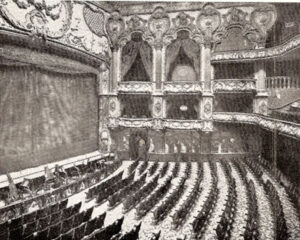
Bram Stoker’s day job was as the business manager to actor Henry Irving and later the Lyceum Theatre in London, England which Irving owned.

Lyceum Theatre

Before exploring how Stoker’s “real” work might have influenced his writing, let’s do a quick overview of his life.

Born: November 8, 1847 in Dublin, Ireland (Irish and a Scorpio.)

Education: 1870 Bachelor of Arts in mathematics (?) from Trinity College

First day job: Civil servant working in Dublin Castle for the British royals

First side hustle: Unpaid writer and theatre critic for the Dublin Evening Mail newspaper

First professional turning point: 1878 Because of Stoker’s review of Hamlet’s Shakespeare published in the newspaper, he meets acclaimed actor Henry Irving who offers Stoker a job as the business manager for Irving and the famed Lyceum Theatre in London

Personal life: 1878 Marries actress Florence Balcombe (who had previously been engaged to Oscar Wilde)

One child: 1879 Irving Noel Thornley (notice that Stoker’s only child is named after his boss Henry Irving)

Dracula: 1897 Published in England; 1899 published in America

Literary career: 1902-1911 Continues writing and publishing novels, lectures, & nonfiction

Deceased: April 20, 1912

To begin with, I’m impressed by a writer who can do math, but the university he obtained a Bachelor of Arts from is vague about the emphasis of the degree. Stoker claimed he graduated with “Honors in Pure Mathematics” then went on to keep the books for a major theatre company. Works for me. Obviously, Stoker was that creator.

He became interested in theatre in college but was known as an exemplary athlete in several sports. He must have recognized the importance of making a living and spending personal time on less lucrative endeavors such as writers. Reading Stoker’s life reminds me of Steven King’s beginnings as a school maintenance worker who wrote in the evenings. It’s no surprise then that Stoker worked the day job to pay the bills while writing pro bono for a local publication. Between his education and work experience and interest in theatrical arts, Stoker did what most writers do: endure reality to support our fantasies.

What does a theatre business manager do? They watch the bottom line like a hawk making sure that there is money enough to keep the actors paid and clothed and the audience intrigued enough to buy tickets. Henry Irving was one of the most famous, sought-after actors of the time. He was too busy at his craft to bother with these all-important tasks. Without the building, lights, costumes, advertising, and a script, Irving was nobody. He knew enough to hire an astute and admiring assistant. My own work history includes more than one stint as a business manager for a local ballet company followed by a stint as the personal manager of a popular ballet teacher. I performed exactly the tasks Stoker did for Irving: correspondence, advertising, travel arrangements, negotiations, purchases of everything from food to shoes to reading materials, and much more. All while continuing my freelance work as a dance writer.

The life of an actor (or dancer, musician, author) then and now depends on ticket sales. Tickets are bought because of notoriety. The public will pay for a ticket stub and the bragging rights to be able to say that they saw so-and-so live and in person on stage. Swell. But the pace and the stress are exhausting. It is a blood-sucking existence because fame is fleeting, and artists know it. When a person is at the top of their game, that’s when the fans want to see them. Scheduling and traveling are grueling because an artist never knows when the public will turn away to follow the next fad. The managers are just as used up as the artists.

Then what?

Exactly. Most of the time, there is no notice, no date when an actor’s fame fades. It is usually a gradual thing like the ebb and flow of low tide on the beach when most sun worshipers are inside having dinner. No one is on the sand to witness the slow rise and gentle recline of a weak little wave as it barely wets the sand on its way in then out for good. Until another bigger, grander, wider, more expansive wave comes in later. Does a surfer run for a ripple? No. The crowd swells for a big swell. It’s that way with performers and their managers.

What happens next is the time to realize how exhausted on every level you are, be it performer or support staff. It can be months before energy returns. It can be years before you feel like working at all. After the hustle and adrenaline rush of a performance career, the after party is more like a car running out of gas in the middle of the highway. There is no juiciness left. There is no life force left. You feel as if the blood that used to pump through your veins and kept you on the cutting edge has been literally sucked out of you and all you have left is a carcass not good for much of anything.

“Kiss today good-bye” is a true and famous line from the song “What I Did for Love” from the Broadway musical A Chorus Line. ACL is about the fleeting life of dancers in the chorus line. Although ACL was written in the 1970s, the feeling of nothingness when the career is over is what we humans believe to feel like being dead. The walking dead. The un-dead as Bram Stoker originally titled his novel eventually called Dracula.

A Dracula sucks the life out of another being so that Dracul can go on living. The theatre will suck the life out of the players so that it can go on existing. Did Stoker’s thankless day job as a business manager to a famous actor make him feel as if the fluid of life, his blood, had been drained from his body? We all do something for love at least once in a lifetime.

Be well, write well!

~Joy

(Image The Graphics Fairy.)


DRACULA WEEK ’25: DRACULA IS A ROMANCE??

Monday 27 October 2025

#1 Dracula is a Romance?

One day my mentor in graduate school said to me, “Consider the book Dracula as a romance novel.” As a romance author myself, it hadn’t occurred to me to view this enduring work as a romance novel, but as one of my favorite all-time books, Bram Stoker’s Dracula rates high for me. The rating is based on the facts that I adore epistolary fiction and no matter how many times I read Dracula, I find something new or different to think about. Why couldn’t I see Dracula as a romance novel?


The left side of my brain immediately reminded me of the eight elements of the romance novel defined by educator and researcher Pamela Regis in her book A Natural History of the Romance Novel (University of Pennsylvania Press, 2003.)


  1. society defined
  2. the meeting
  3. the barrier
  4. the attraction
  5. the declaration
  6. point of ritual death
  7. the recognition
  8. the betrothal


My mentor’s intriguing statement got me looking at Dracula in a different way. Right away, I ran into a brick wall. Who are the love interests in the story? The standard romance tropes require that two individuals develop an attraction followed by overcoming obstacles resolved by culminating in an agreement between the parties to make changes necessary to commit to a lasting relationship.


Now you may be thinking, “The obvious romantic couple is Miss Mina Murray and Jonathan Harker because they end of happily married and with a son they name after the man who gave his life to save them.” As a matter of fact, Stoker tries to tie up several relationships at the end of the book explaining that Godalming and Dr. Seward live and are also “both happily married.” And yes, the final remarks of that stalwart Van Helsing point to maybe Stoker wanted readers to see the story of Dracula as a romance with a happy ending:


“We want no proofs; we ask none to believe us! This boy will some day know what a brave and gallant woman his mother is. Already he knows her sweetness and loving care; later on he will understand how some men so loved her, that they did dare much for her sake.”


Doesn’t this sound like the end of a romance novel to you? It does to me, but I must admit that other elements of the story stand out so vividly for me that seeing a love story as the main idea hadn’t crossed my mind until those words from my mentor.


What do you think? Can you sink your teeth into the idea of the novel Dracula as a romance? Why or why not?

Be well, write well!

~Joy

(Image Graphics Fairy)

XXXXXXXXXXXXXXXXXXXXXXXXXXXXXXXXXXXXXXXXX

OCTOBER THEORY FOR WRITERS: Finish the Year Fresh Instead of Fatigued

Tuesday 21 October 2025

October Theory for Writers: Finish the Year Fresh Instead of Fatigued


Open a book, any book, to a random page (to the page of today’s date works.) Copy one sentence from that page into a journal or a blank page. Close your eyes, take a deep breath, and repeat the sentence in your mind three or more times until a new idea pops into your thoughts. Write the new idea down and keep writing if inspired.

Count things for a whole day. Consciously stop and count things/people/ideas as often as you can remember to do so for one day. Journal at the end of the day about the experience. Recognizing patterns is a great way to train your mind to organize your stories.

Talk nice to yourself in your journal instead of beating down everything and everybody. Just for the rest of the year, write balance into your journal pages. Consciously recognizing the pros and cons of just about everything can improve mood and self-esteem.

Organize something, anything! Digital or tangible, spend one hour of one day in October sorting, donating, and trashing at least one of those piles or drawers or stashes. Promise to repeat this in November and December. Write this into your planner if you think you’ll need the nudges. Cleaning out a closet or a junk drawer can create an amazing feeling of satisfaction and accomplishment.

Build something calming and relaxing into three or more days a week for the rest of the year. Five minutes of resting on your back with a cloth over your eyes. Short walks. Listen to quiet music or nature sounds for five minutes. Sit still for five minutes inside of someplace crowded like a coffee shop and cultivate being calm in the midst of chaos. Practice counting breaths or a meditation method of your choice. Builds mental clarity and focus.

Exercise 20-minutes a day, five times a week. Gentle movement is fine but include a cardio workout once a week if you can. Sitting and lifting small hand weights IS cardio! Better energy, improved confidence, and physical strength are some of the side effects.

Reflect on the last nine months of the year, use the above ideas to select Reasonable goals to end this year, and Reach out to another writer this month either in person, online, on the phone, or mail an actual card or letter to them! Stamps are pricey, but one won’t break the budget.

  • Open
  • Count
  • Talk
  • Organize
  • Build
  • Exercise
  • Reflect

The end is always the beginning if you want it to be.

Write on!

~Joy


Advertisement


My WriteDay Subscription Box

Disclaimers

This article may contain affiliate links which may result in the author receiving a commission when readers purchase items through the links.

You are receiving this message because you previously signed up for notifications or participated in a program/course with Joy. You may unsubscribe at any time.

My ideas are not ever meant as a substitute for consulting with a qualified health professional.


JOY E. HELD is an author, educator, editor, book coach, entrepreneur, and literary citizen responsible for this site and its contents. She is the author of

Writer Wellness: A Writer’s Path to Health and Creativity (Headline Books, Inc., 2020)

Writer Wellness Workbook: A Guided Workbook and Journal to Accompany Writer Wellness: A Writer’s Path to Health and Creativity (Headline Books, Inc., 2023)

The Mermaid Riot (Fire and Ice YA, 2024) Young Adult Historical Fantasy

She writes spicy historical fiction under a pen name.

She is the winner of multiple writing and book awards:

West Virginia Writers, Inc. Annual Writing Contest, Honorable Mention, Novel, 1998.

New York Book Festival, Honorable Mention, Writer Wellness, 2020.

Next Generation Indie Book Awards, Finalist, Writer Wellness, 2021.

Northeast Ohio Romance Writers of America, Member of the Year, 2020.

Northeast Ohio Romance Writers of America, First Book Award, 2020.

She is an adjunct faculty member in the Southern New Hampshire University Online MFA Creative Writing.

She is a proud graduate of Seton Hill University in Greensburg, PA with an MFA in Writing Popular Fiction.

She is a member of The Authors Guild and the Society of Children’s Book Writers and Illustrators.

Joy is the founder and CEO of My WRITEDAY Subscription Box for writers and readers.


Buy me a coffee

XXXXXXXXXXXXXXXXXXXXX

MY WRITEDAY BOX REVEAL SEPT/OCT 2025

Monday, 20 October 2025

Welcome to “Ready, Set, Memoir” the September/October 2025 2nd Anniversary box reveal!

When I first checked out the feature craft book for this box, I almost got interested in writing my memoir because RSM is so cleverly organized to entice anyone to write their life story. The reason I haven’t done it is because I don’t think I’m that unique in the world of creative people who do what I do from sun-up to late in the night. I have never thought anyone would be interested in my personal journey. Then I realized that I have tons of chapters about my life already written in the years and years of journaling I’ve done. This book has given me a new perspective on writing my memoir. It might do the same for you!

What’s in “Ready, Set, Memoir” the Sept/Oct ’25 Box?

Let’s look at it all.

1.Ready, Set, Memoir by Lindsey Grant is a colorful yet practical approach to determining IF you have a story then how to go about getting started.


  1. Candied Pecans from Earthside Farms is a delicious treat to have nearby. They are super yummy, pecans are healthy, and surprisingly, a few nuts go a long way. (That sounds to me like it applies to more than these pecans LOL.) Ta-da! Portion control.
  2. Journal Prompts These ready-made journal prompts are perfect springboards for when you want to journal but need an idea to get the pen (or keyboard) in motion. I glue one to a page then respond but you can copy it as well.
  3.  Inspirational Pencil Set These pencils are great to place around the house or in your journal-to-go bag so you are always with a writing tool. My idea of hell is paper without a pen/pencil!
  4. There are reading and writing stickers, a Thoughtfull pop-out journal prompt, MWD drink coaster, an embellished paperclip, and an enamel pin.
  5. 52 Weeks of Book Quotes This is a clever calendar that is NOT a calendar. It can be used forever for journal prompts, blog posts, and general inspiration.

Subscribers, what did you think of this box? I’d love to know. MWD unboxing video??? Yes, please. Have you ever done an unboxing of MWD on Instagram? I didn’t see it!! Please tag me. Thank you.

https://www.instagram.com/mywriteday/

and Facebook

https://www.facebook.com/profile.php?id=61550745717735

My WriteDay subscription box for writers will be open to new subscribers on Monday, November 3 at noon EST.

My WriteDay Subscription Box


https://www.mywriteday.com

MWD could use your help spreading the word about our box. There are a few ways to do this:

  • Post on social media
  • Share your box with others
  • Mention us in your newsletter if you have one
  • Give out information post cards (which I will supply to you on request) at critique groups and writing conferences

I hope your WriteDay is fantastic!

~Joy


Disclaimer

This publication may contain affiliate links that may result in a small compensation to the author if you click and make a purchase. Thanks for your support! Please support our advertisers.


Advertisements


Buy me a coffee

XXXXXXXXXXXXXXXXXXXXXXXXXXXXXXXXX

The Braveheart of a Writer or Writing a Query Letter

Monday 20 October 2025

The Braveheart of a Writer or Writing a Query Letter

It takes a certain amount of bravery to be a writer. A writer also needs thick skin in certain places so as not to be discouraged by the “commentary” we invite to our work from family, friends, cohorts, editors, publishers, and agents. And readers. Once the manuscript is ready for consumption, meaning it has been edited and revised by more than just the writer, one of the first efforts to shove our stories into the ether for others to consider is submitting to literary agents. The three parts of a query letter are

  1. The hook
  2. The book
  3. The cook

These resources may be helpful in your query letter endeavors.

Six steps to getting your query letter out of the slush pile

Jane Friefman query resources

How to Immediately Improve Your Query Letter’s Effectiveness

Successful Query Letters Writers Digest

11 Successful Query Letter Examples

A query letter in this business is similar to folding a sheet of paper into the shape of an airplane and throwing said letter off of a cliff. Someone may catch it, read it, and yell back at you. Or it may be caught by the wind and…

Be well, write well!

~Joy


Advertisement


My WriteDay Subscription Box


Disclaimers

This article may contain affiliate links which may result in the author receiving a commission when readers purchase items through the links.

You are receiving this message because you previously signed up for notifications or participated in a program/course with Joy. You may unsubscribe at any time.

My ideas are not ever meant as a substitute for consulting with a qualified health professional.


JOY E. HELD is an author, educator, editor, book coach, entrepreneur, and literary citizen responsible for this site and its contents. She is the author of

Writer Wellness: A Writer’s Path to Health and Creativity (Headline Books, Inc., 2020)

Writer Wellness Workbook: A Guided Workbook and Journal to Accompany Writer Wellness: A Writer’s Path to Health and Creativity (Headline Books, Inc., 2023)

The Mermaid Riot (Fire and Ice YA, 2024) Young Adult Historical Fantasy

She writes spicy historical fiction under a pen name.

She is the winner of multiple writing and book awards:

West Virginia Writers, Inc. Annual Writing Contest, Honorable Mention, Novel, 1998.

New York Book Festival, Honorable Mention, Writer Wellness, 2020.

Next Generation Indie Book Awards, Finalist, Writer Wellness, 2021.

Northeast Ohio Romance Writers of America, Member of the Year, 2020.

Northeast Ohio Romance Writers of America, First Book Award, 2020.

She is an adjunct faculty member in the Southern New Hampshire University Online MFA Creative Writing.

She is a proud graduate of Seton Hill University in Greensburg, PA with an MFA in Writing Popular Fiction.

She is a member of The Authors Guild and the Society of Children’s Book Writers and Illustrators.

Joy is the founder and CEO of My WRITEDAY Subscription Box for writers and readers.


Buy me a coffee

XXXXXXXXXXXXXXXXXXXXXXXX

Searching & Selecting a Literary Agent?

Monday, 6 October 2025

Why Professional Writer Organizations Are Mostly Worth the Dues When It Comes to Searching and Selecting a Literary Agent

Genre specific writing organizations offer different benefits to members. One of those benefits related to the literary agent search that is often overlooked is the pre-screened list of agents actively seeking submissions in a particular genre that some groups offer their members. For example, the dues to the Romance Writers of America national chapter includes access to a members only resource listing agents (there’s one for qualifying markets too) that RWA has already vetted as to their willingness to accept submissions from RWA members. Historical Novel Society also offers this to members in good standing.

The agent search can feel daunting because the system has evolved to where an agent is almost an absolute requirement for getting the attention of a traditional Big Five publishing house because BFs generally accept agented submissions only. This has increased the number of agents, but it has not increased the value of having an agent.

Another agent related value to membership is that the warehouse organizations (and some smaller regional groups) invite agents to their conferences where you can schedule a one-on-one meet with an agent and pitch your work. Sometimes they are group pitch sessions. They may also bring in editors from publishing houses. I’ve known writers who only attend in-person pitches at conferences and have never cold emailed an agent or editor. Many of them have secured agent representation this way.

These resources are workarounds that are worth the consideration because the organization has done some of the leg work for you. It’s a cut to the chase sort of process that might possibly reduce the amount of time and research you should do when selecting a literary agent. But it comes with the price of the annual membership dues or the conference fee. And you still have to do the advance research in order to choose the right potential agent to meet with.

I’ve had a singular bad experience with this process when an agent listed in the member’s only resource accepted me as a client then turned around and said I had to pay for his wife to edit my manuscript before he would offer it to publishers. That was a price I wasn’t willing to pay. The writer organization heard from me and the agent was eventually removed from the list. I had the emails to prove the demand.

Oh, and watch out for schmagents (amateur, marginal, and incompetent) as noted in this article from Writer Beware blog on the Science Fiction and Fantasy Writers Association!

https://www.sfwa.org/other-resources/for-authors/writer-beware/agents/

Be well, write well!

~Joy


Advertisement


This article may contain affiliate links which may result in the author receiving a commission when readers purchase items through the links.

You are receiving this message because you previously signed up for notifications or participated in a program/course with Joy. You may unsubscribe at any time.

My ideas are not ever meant as a substitute for consulting with a qualified health professional.


JOY E. HELD is an author, educator, editor, book coach, entrepreneur, and literary citizen responsible for this site and its contents. She is the author of

Writer Wellness: A Writer’s Path to Health and Creativity (Headline Books, Inc., 2020)

Writer Wellness Workbook: A Guided Workbook and Journal to Accompany Writer Wellness: A Writer’s Path to Health and Creativity (Headline Books, Inc., 2023)

The Mermaid Riot (Fire and Ice YA, 2024) Young Adult Historical Fantasy

She writes spicy historical fiction under a pen name.

She is the winner of multiple writing and book awards:

West Virginia Writers, Inc. Annual Writing Contest, Honorable Mention, Novel, 1998.

New York Book Festival, Honorable Mention, Writer Wellness, 2020.

Next Generation Indie Book Awards, Finalist, Writer Wellness, 2021.

Northeast Ohio Romance Writers of America, Member of the Year, 2020.

Northeast Ohio Romance Writers of America, First Book Award, 2020.

She is an adjunct faculty member in the Southern New Hampshire University Online MFA Creative Writing.

She is a proud graduate of Seton Hill University in Greensburg, PA with an MFA in Writing Popular Fiction.

She is a member of The Authors Guild and the Society of Children’s Book Writers and Illustrators.

Joy is the founder and CEO of My WRITEDAY Subscription Box for writers and readers.


Buy me a coffee

XXXXXXXXXXXXXXXXXXXXXXXXXXXXX